Home
0
Home

What Are the Best CE Options for Enrolled Agents?

The Last Self-Study CPE Website You Will Ever Need
(Click for Subscriptions)


Key Takeaway

This page compares seven CE providers for enrolled agents, including CPEThink.com, WebCE, Sequoia CPE, Gleim CPE, Western CPE, CeriFi CPEdge, and Becker, and outlines what the IRS requires to meet the 72 hour three year enrolled agent CE cycle.

  • Explains that enrolled agents must complete 72 hours of CE every three year cycle based on the last digit of their Social Security number, including 6 hours of ethics from IRS ethics programs, with 16 hours required annually and 2 of those hours on ethics.
  • Notes that ethics hours cannot be applied toward the federal tax or federal tax law update requirements, and that only additional federal tax law update hours can satisfy the federal tax law requirement.
  • Lists what to check before choosing an enrolled agent CE provider, including IRS approval, qualifying ethics courses, reporting speed of credits to the IRS, multiple learning formats, and cost structure.
  • Explains the documentation enrolled agents must keep for at least four years, including the provider name, course title and approval number, credits claimed, dates attended, and the completion certificate.
  • Compares pricing and format across providers, noting that CPEThink.com publishes the price of every course from 13.45 dollars to 162.95 dollars, while WebCE, Western CPE, and CeriFi CPEdge do not publicly list enrolled agent pricing.
  • CPEThink.com is the fifth online CPE provider in the world, in business since 2004, and holds both IRS CE Provider status, ID 1SXC8, and NASBA QAS Self Study Sponsor status, ID 108299, backed by a 100 day money back guarantee and ratings of 4.8 to 4.9 out of 5.0.


What Are the Best CE Options for Enrolled Agents?: Frequently Asked Questions (FAQs)

It compares CPEThink.com, WebCE, and Sequoia CPE, along with Gleim CPE, Western CPE, CeriFi CPEdge, and Becker.

They must complete 72 hours every three year cycle, including 6 hours of ethics, with 16 hours and 2 ethics hours required each year.

They must come from IRS ethics programs, and cannot be applied toward the federal tax or federal tax law update requirements.

Check for IRS approval and qualifying ethics courses, along with reporting speed to the IRS, multiple formats, and cost structure.

Keep the provider name and course title, along with the approval number, credits claimed, dates attended, and the completion certificate, for at least four years.

It is the fifth online CPE provider in the world, in business since 2004, with a 100 day money back guarantee and ratings of 4.8 to 4.9 out of 5.0.

What Are the Best CE Options for Enrolled Agents?


Item Types:
Field of Study:
Authors:
CPE Hours:
Keyword:
Records per page:
All Items
Records per page:


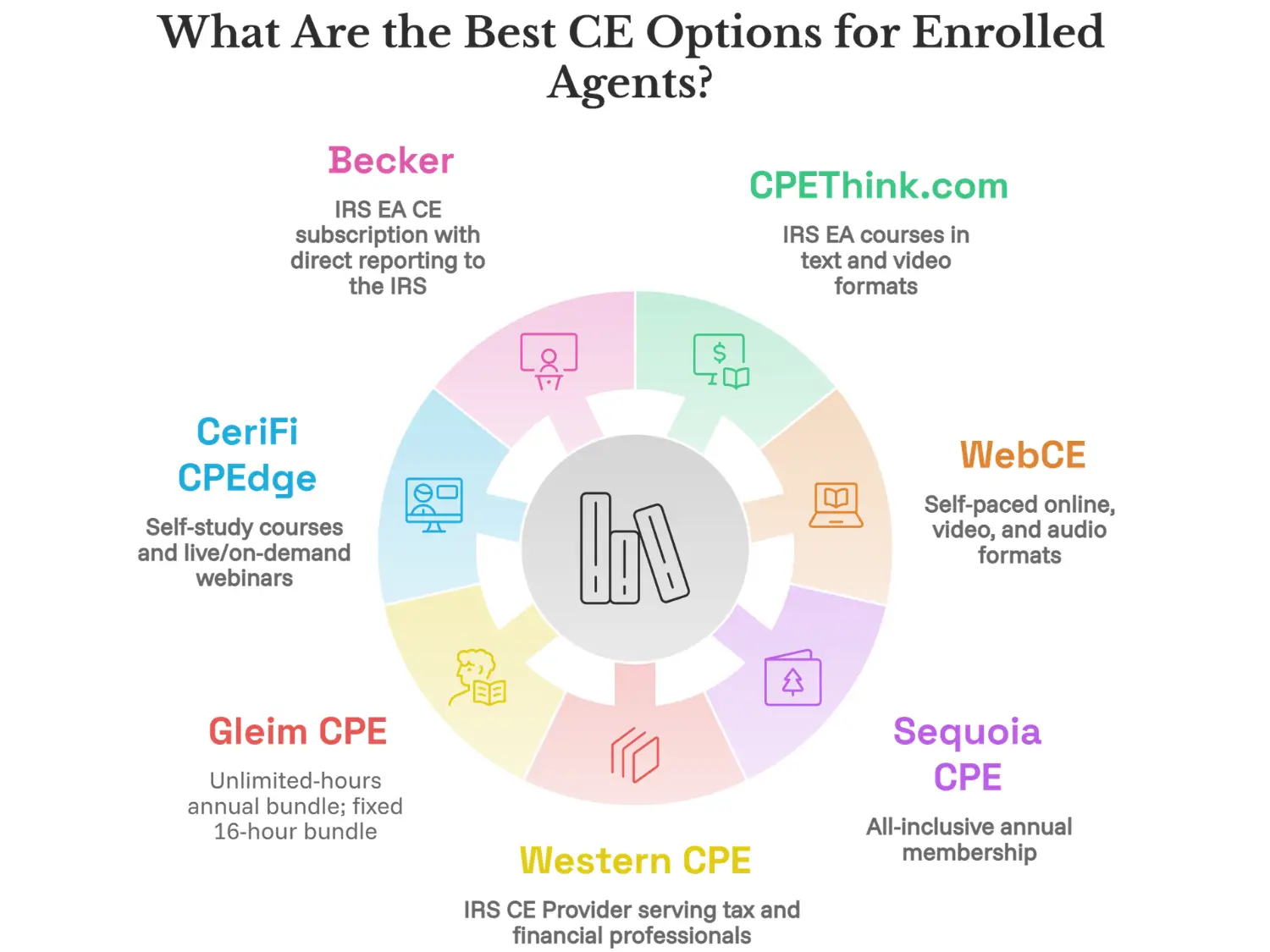
The IRS mandates that all enrolled agents complete CE hours in every enrollment cycle. But which providers offer the best enrolled agent continuing education? This page tries to find the answer by comparing seven well-known EA CE sponsors.


ProviderEA CE Offering & FormatCourse Volume (if published)Pricing (if published)
CPEThink.comIRS EA courses in federal tax law (1SXC8-T), federal tax law updates (1SXC8-U), and ethics (1SXC8-E) program number series, in text and video formatsCatalog changes regularly; not a fixed countIndividual IRS courses $13.45 to $162.95 per course (ethics courses $17.95 to $24.95); subscriptions also available (see CPE subscriptions)
WebCEIRS EA CE: ethics, federal tax law updates, business tax, individual tax; self-paced online, video, and audio formatsFull catalog; count not publishedNot publicly listed; 'Enrolled Agent All Access' is a named package but price is not shown on site
Sequoia CPEIRS EA CE under an all-inclusive annual membership; no added exam, grading, or certificate feesNot specified in published FAQ$99 per year EA Membership (confirmed on Sequoia CPE's own FAQ page)
Gleim CPEIRS EA CE bundles: an unlimited-hours annual bundle, and a fixed 16-hour bundle covering ethics, federal tax update, and 3 other required topics16-Hour Bundle = 5 fixed courses; Unlimited Bundle not course-limitedUnlimited Hours Bundle $199.92 per year; 16 Hours Bundle $76 (confirmed on Gleim's own EA CE packages page)
Western CPEIRS CE Provider (ID 0MYXB) serving tax and financial professionals broadly, including EAsNot verified in this round of researchNot publicly listed; could not verify EA-specific package pricing
CeriFi CPEdge (Checkpoint Learning)CPE tracker packages explicitly covering CPAs and Enrolled Agents, with self-study courses and live/on-demand webinarsProfessional tier lists 500+ self-study courses; higher tiers add moreNot publicly listed; three named tiers (Professional, Premier, Premier Plus) with no prices shown on site
BeckerIRS EA CE subscription (12 months, 160+ hours, no credit limits), with direct reporting to the IRS generally within 1 to 2 days of completion, a compliance tracker, webcasts, and video self-study75+ courses (per Becker's own EA CE comparison page)EA CE Subscription $329.00 list price, shown at $197.00 on Becker's EA CE page (checked 2026-11-06)


How Many CE Hours EAs Need and When They Are Due

Continuing education options for enrolled agents compared by EA CE offering, format, course volume, and published pricing

  • You have to complete 72 hours every three-year enrollment cycle.
  • The renewal cycle is determined based on your SSN's last digit.
  • Those 72 hours must include 6 hours of ethics.
  • Ethics hours must come from IRS programs in the ethics category; a general or state-specific ethics course (often required by state boards of accountancy) counts only if it is an IRS ethics program.
  • You can't apply additional ethics hours to meet federal tax/federal tax law update requirements.
  • You can use only additional hours in federal tax law updates to fulfill federal tax law requirements.
  • Each year, you must get at least 16 hours of CE, and two of them have to be on ethics.
  • You may obtain up to 6 instructor hours every year.
  • Your initial enrolled agent CPE requirements vary depending on your initial enrollment.
  • You must take all enrolled agent CE programs from IRS-approved CE providers.
  • All enrolled agent CPE requirements can be met through self-study IRS EA CPE courses, provided they come from an IRS-approved provider.

Visit this page for more information on IRS enrolled agent CPE requirements.

What The 2-Hour Ethics Requirement Covers

This requirement primarily focuses on federal tax practice standards and ethics. IRS EA ethics courses specifically cover topics related to:

  • Rules established by the IRS Circular 230 that govern practitioner duties, practice before the IRS, and restrictions.
  • Tax preparers' ethical duties like standards for advising clients on tax returns, professional conduct, conflicts of interest, and confidentiality.
  • Unethical practices and their consequences like investigations conducted by the IRS Criminal Investigation Division, and penalties and other disciplinary actions taken by the OPR (Office of Professional Responsibility).
  • Practice issues and scams, often explained through real-world examples.

How To Plan the Ethics Credits Effectively

  • One often overlooked catch of EA credits is that they're annual. This means you can't earn all six credits in one year and skip the other years. So, make sure to dedicate two hours to ethics every year.
  • Complete the annual 2-hour course early in the year to eliminate the risk of forgetting or last-minute scrambling.
  • Spread your targeted annual credit hours across quarters, with the ethics component in the first one.
  • Choose a learning format that meets your schedule.

What To Check Before Choosing an EA CE Provider

  • IRS approval: Confirm that the provider is approved by the IRS to offer continuing education. As stated above, CE obtained from an unapproved provider doesn't help meet IRS requirements. Check the IRS-Approved Continuing Education Providers List for this.
  • Ethics courses: Make sure that the provider has courses that specifically satisfy the annual two-hour ethics requirement of the IRS. Don't assume that any ethics course would do this. Plus, see if it has enough number of courses covering a variety of tax-related topics to help meet both your annual and three-year CE requirements.
  • Reporting speed of credits to the IRS: Your provider must report your credits obtained from IRS CE courses to the IRS. So, check the reporting frequency. Accurate, timely reporting helps avoid complications during license renewal. Use your PTIN account to view the reported courses. It's important to note that you must give your provider the correct spelling of your name and your PTIN. Also, confirm that the PTIN you gave to your provider exactly matches the PTIN in your online PTIN account or your welcome letter.
  • Multiple learning formats: Look for different learning formats like text-based self-study courses, on-demand video courses, and live webinars that align with your preferred learning style and help you balance learning and professional workload.
  • Issuance speed of completion certificates: Confirm that completion certificates are issued promptly and if you can access them for future reference. You should also maintain your own documentation instead of relying solely on the provider's system.
  • Cost structure: Compare individual course fees and unlimited-access CPE subscriptions. The decision should depend on your learning needs, preferred learning formats, and CPE budget.
  • Additional charges: Check whether there are additional charges for IRS credit reporting or for access to the full course library.

How To Maintain Proper Documentation of EA CE Courses

For each completed course, maintain these records for at least four years as the IRS may audit your CE records.

  • The CE provider's name.
  • The course's title, its approval number, and the program content's copy.
  • The program's location.
  • The number of credits claimed for it.
  • The date(s) attended.
  • Textbook, written outlines, and/or electronic materials relevant to it.
  • If applicable, the name(s) of the instructor(s), speaker(s), or discussion leader(s).
  • The completion certificate and/or statement of attendance hours signed by the CE provider.

Why Choose CPEThink for Enrolled Agent CE Courses?

  • The fifth online CPE provider in the world, CPEThink has been in the industry for more than two decades (founded in 2004).
  • It's both an IRS CE Provider (ID 1SXC8) and a NASBA QAS Self-Study Sponsor (ID 108299).
  • It offers IRS EA courses in ethics (program numbers in the 1SXC8-E series), federal tax law (1SXC8-T series), and federal tax law updates (1SXC8-U series).
  • It offers individual IRS courses priced from $13.45 to $162.95, and it also offers subscriptions. Get the full details on its CPE subscriptions page.
  • As you can see in the table, while pricing is not publicly listed for several providers, CPEThink publishes the price of every course.
  • You get a 100-day, 100% money-back guarantee.
  • It has ratings of 4.8 to 4.9 out of 5.0 on Trustpilot and Shopper Approved.

Start your enrolled agent continuing education today!


seperator


Check out what other customers are saying.


Thank you for taking one of our free courses. We would like to be able to let you know when we add free courses or have special offers and will never spam you or share your address with anyone. If you are Ok with that please reply with "Ok" or if not please reply "No Thanks". Either way enjoy your free CPE course.
  
Exam completed on .

Do you want to add the course again?