0

Estate Tax and Planning CPE Courses For CPAs |
| The Last Self-Study CPE Website You Will Ever Need (Click for Subscriptions) |
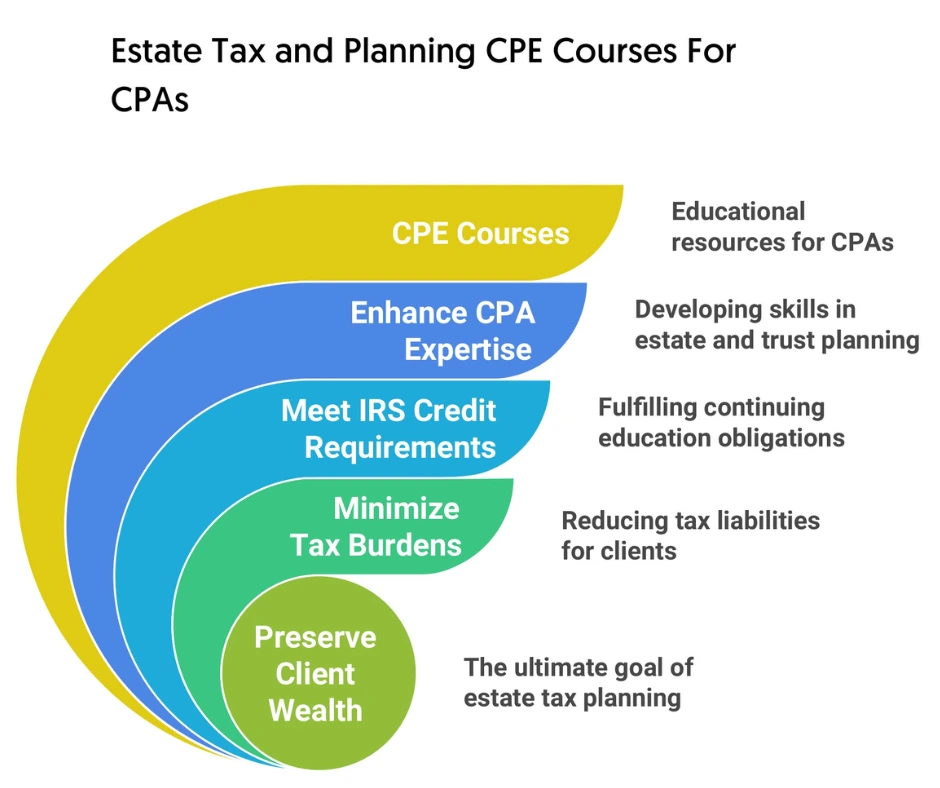
This page offers a comprehensive set of self-study CPE courses focused on estate tax and planning, enabling CPAs and tax professionals to meet IRS credit requirements while mastering strategies to minimize tax burdens and preserve client wealth. It serves as both a compliance tool and a practical guide for delivering high-value advisory services in estate and trust planning.
1. Who is this list of CPE courses for?This list of CPE courses is designed for CPAs, accountants, and tax professionals, particularly those in the CPA and EA audience, who want to develop or enhance their expertise in estate tax and planning strategies. 2. What is this list of CPE courses about or what problem does this course solve?These courses focus on estate tax and planning, helping professionals understand how to minimize tax liabilities, manage wealth transfer, and apply strategies such as trusts, gifting, and estate structuring to preserve client wealth across generations. | 3. Why is this list of CPE courses important to a CPA, Accountant, or IRS Enrolled Agent?Because most courses include IRS credits, this list is important for professionals who need to meet IRS continuing education requirements while building specialized knowledge in estate, gift, and transfer taxation. 4. When is this list of CPE courses relevant or timely?This list is especially relevant when professionals are advising clients during major life and financial events, such as retirement, inheritance planning, or significant asset accumulation, or when staying current with annual estate tax thresholds and laws (e.g., 2025-2026 updates). | 5. Where can this list of CPE courses be found and accessed?These courses are available through the Cpethink online self-study CPE platform, where users can search, select, purchase, and complete text-based estate planning courses directly from the course catalog page. 6. How is a list of CPE courses like this consumed or used?The courses are completed as self-study text programs, allowing professionals to progress at their own pace while earning CPE and IRS credits and applying estate planning concepts directly to client advisory work. |
Estate tax planning is much more than just crunching numbers; it's really about protecting the legacy one has spent their life building. If a person doesn't plan ahead, estate taxes can chip away at their wealth, leaving their family with headaches and less than they'd hoped to pass down.
But with good planning, they can cut down on taxes, keep more of their assets intact, and make sure their wishes are honored.
These days, estate tax planning feels like a necessary step for anyone with significant assets. It's not only about taxes; it's about using smart strategies, complying with laws, and thinking about the family's future to bring everything together into one solid plan.
If you're a CPA aiming to be a trusted advisor for clients who want to maximize what they leave for their loved ones, estate planning CPE should be high on your list.
On this page, you'll see why estate and trust CPE matters and how it pushes your career forward.
As mentioned above, the primary objective of estate tax planning is to safeguard client wealth and minimize tax liabilities. While some individuals face a dilemma of hiring an estate planning CPA vs a lawyer, the former is the right choice when it comes to optimizing tax strategies and managing financial compliance.
Here are some common strategies that you'll master when pursuing real estate tax CPE.
This is the easiest method to reduce estate tax liability while a person is still alive. In 2026, an individual can give a maximum of $19,000 per person, and married couples may take it to $38,000 per recipient.
These trusts allow an individual to transfer assets to their spouse, while still having control over them. As they reduce taxable estate while providing the spouse with financial security, many people choose them.
While life insurance proceeds may push one's estate beyond the exemption threshold, an ILIT eliminates them from the taxable estate. As the trust holds the life insurance policies, the death benefit stays outside the estate.
Another effective estate tax planning strategy, these trusts reduce one's tax liability on the estate, while maximizing the wealth transferred to their loved ones. Here, the grantor transfers assets to the trust for a certain period of time and retains the right to receive annuity payments from it. If the assets appreciate faster than the IRS interest rate, the beneficiaries receive the excess growth tax-free.
Here, the trust owns an individual's personal residence and lets them use it for a specific period of time. At the period's end, the residence is transferred to the person's beneficiaries without incurring estate taxes.
There are two types of charitable trusts.
Here, a charitable organization receives a part of the trust's income for a specific period of time. After that period, the trust's remaining assets are distributed to the trust beneficiaries. The donations made within the trust's term can be used to reduce estate tax liabilities.
In CRTs, the grantor transfers assets into the trust, and either they or the trust beneficiaries receive payments from it for a specific period. After that, the remaining assets are transferred to one or more qualified charitable organizations.
FLPs can help reduce estate tax liabilities through valuation discounts while transferring partnership interests to family members. These also provide centralized management for family assets.
This is designed for:
By completing estate tax CPE, you can:
This information becomes relevant during major events such as acquisition of property, marriage, the birth of children, or retirement. The knowledge gained from CPE in estate tax also becomes critical when computing tax liabilities based on the exact filing threshold.
Estate tax planning can be done for any individual based in the U.S. You can also use your knowledge to help non-residents who have assets in the U.S. with the total value going over $60,000.
Estate tax CPE enables you to:
Effective estate tax planning is complex and requires a combination of strategies. To master those strategies and help clients address the above challenges, you should:
With a deep understanding of estate tax planning, you can make sure that an individual's life's work benefits the people they care about most. The sooner a person begins, the more options they get to minimize estate tax liabilities and maximize the value passed on to their next generations. By providing them with professional guidance and careful planning, you can help them secure their family's financial future and preserve the legacy they've built.

Check out what other customers are saying.




 Login/Register