0

Forensic Accounting CPE Courses for CPAs |
| The Last Self-Study CPE Website You Will Ever Need (Click for Subscriptions) |
This page presents a selection of forensic accounting CPE courses designed to help CPAs and other accounting professionals build expertise in fraud detection, investigation, litigation support, money laundering analysis, financial reporting fraud, and related technology and practice management topics. Users can select, complete, and apply coursework that supports credential specific CPE requirements while strengthening practical competency in forensic engagements.
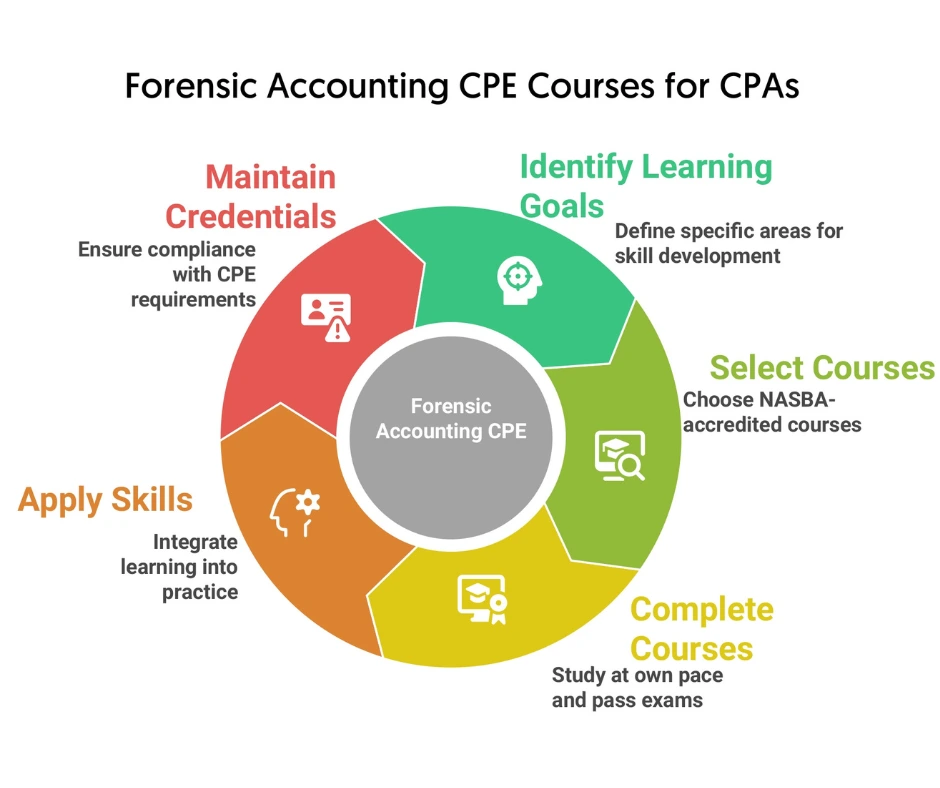
1. Who is this list of CPE courses for?This list is for CPAs and other accounting professionals practicing or seeking to practice in forensic accounting, including Certified Fraud Examiners (CFEs), holders of the Certified in Financial Forensics (CFF) credential, auditors, compliance officers, and CFOs involved in fraud investigations, litigation support, or regulatory reviews. 2. What is this list of CPE courses about or what problem does this course solve?The list covers forensic accounting topics including fraud detection, investigation and litigation support, financial reporting fraud, money laundering through the U.S. financial system, modern technologies such as AI, blockchain, crypto, RPA, and cybersecurity, project management duties, and conflict management in practice, addressing knowledge gaps related to evolving financial crimes and sophisticated fraud schemes. | 3. Why is this list of CPE courses important to a CPA or Accountant?These courses support credential-specific CPE compliance, deliver practical knowledge through case studies and real-world applications, and reinforce professional credibility when presenting defensible evidence in legal proceedings. 4. When is this list of CPE courses relevant or timely?The list is relevant year round to meet annual, biennial, or triennial CPE reporting requirements for CPAs, CFEs, and CFF credential holders, and whenever professionals conduct fraud investigations, prepare for litigation, or advise clients on risk management. | 5. Where can this list of CPE courses be found and accessed?These courses can be found and accessed online through the Cpethink.com platform in text or video format, with credit values ranging from a single to several CPE hours and prices ranging from $10 to $100 per course. 6. How is a list of CPE courses like this consumed or used?Learners enroll online, receive instant access to course materials, study at their own pace, complete the final examination within one year, and receive a completion certificate that can be stored locally, in the cloud, or uploaded to a CPE tracker. |
The world of finance moves fast, and it's only getting more complicated than ever. That's why forensic accounting matters so much these days. Fraud happens, corporate scandals make headlines, and lawsuits get messy. As a result, CPAs and other accountants cannot just crunch numbers anymore; they've to be investigators, too. Forensic accounting CPE gives you those investigative skills.
Maybe you're a CPA or another accounting professional want to know what CPE in forensic accounting involves, this page breaks it all down for you. You'll see what this is, why it's valuable (whether you complete forensic accounting CPE online or in-person), how to pick the right forensic accounting CPE courses, and what to expect from them.
It encompasses technical learning activities that teach accountants to spot red flags, dig into suspicious accounts, meet compliance standards, and help clients out when legal troubles hit. CPE courses in forensic accounting help professionals get sharp at navigating everything, from fraud investigations to big lawsuits and bankruptcies.
Some accountants don't have to do this training, but if you hold specialized credentials such as CFF (Certified in Financial Forensics) from the AICPA or CFE (Certified Fraud Examiner) from the ACFE, you need a certain number of CPE credits to keep your certification. So, for some accountants, staying current isn't optional; it's part of the job.
In the accounting world, specialized skills are always in demand. These courses help improve your investigative acumen and the ability to spot fraudulent activities and support litigation cases. Clients and employers typically value accountants who can clearly present findings in these situations and navigate complex investigations.
High-quality forensic accounting CPE courses often include case studies and real-world applications. This practical knowledge helps you deal with actual instances efficiently.
Meeting credential-specific CPE requirements helps you avoid disciplinary actions or loss of designation. This, in turn, ensures you stay in good standing with the regulatory bodies and are recognized in your field.
With forensic accounting CPE, you get the knowledge and skills to present defensible evidence to withstand legal scrutiny or challenge. Legal authorities depend on expert, technically sound testimonies.
These courses dive into a broad range of specialized topics. The major ones include:
Identifying asset misappropriation, fraud in financial statements, and corruption.
Implementing internal controls to evaluate manual and automated systems for vulnerabilities. This helps prevent fraud while creating an ethical culture.
Identifying fraudster characteristics and early warning signals of corporate fraud and financial anomalies.
Understanding different stages of money laundering and methods to detect it.
Learning the methods to trace the movement of illicit funds, validate background checks, and uncover illegal proceeds and hidden ownership.
Understanding the specific legal requirements for evidence to testify in legal proceedings regarding your findings.
Preparing and presenting expert reports in a clear, concise form for legal proceedings.
Using technology, digital forensics, etc., to detect and analyze suspicious patterns.
Learning the methods to investigate fraudulent transfers during insolvency or bankruptcy.
Understanding how to investigate digital financial fraud, trace the movement of funds stolen through cybercrime, and identify cybercriminals.
Selecting the right CPE courses in forensic accounting really comes down to where you are now and where you want to go down the line. For example, you're aiming to get into fraud detection, digital forensics, or maybe litigation support, your course choices should fit these goals.
Here are some effective methods to choose the correct courses.
Do you need foundational knowledge, or are you after more advanced, specialized skills? Maybe you want to dive deeper into investigative accounting or digital forensics. If auditing is what you do, then courses focused on financial statement fraud analysis might be perfect.
Make sure your courses come from NASBA-approved CPE providers. That way, you aren't just checking a box; you're getting up-to-date, quality information that really matters.
Theories are useful, but nothing beats working through real-world case studies or learning hands-on with Computer Assisted Audit Techniques (CAATs).
If you know you want to focus on a certain industry, pick courses that drill into those specifics. Building that niche expertise helps you stand out.
Think about how you like to learn. Do you prefer forensic accounting CPE courses designed for self-paced study, live workshops, in-person classes, or on-demand webinars? Make your pick based on what works best for your schedule and learning style. If the format fits, those complex concepts will feel easily comprehensible.
Finally, be honest about your knowledge gaps. Find courses that fill them, so you come out stronger and more confident in your work.
Taking online CPE courses comes with a bunch of perks. Here's what stands out:
With online forensic accounting CPE programs, you can set your own pace and study from anywhere. That means you don't have to put your professional responsibilities on pause just to keep your skills sharp. with skill upgrading. Platforms like Cpethink.com really make it easy to juggle work and learning.
Skip the travel, accommodation, and related costs of in-person training. Online programs keep things simple and affordable.
Credible CPE sponsors typically offer online courses that don't just throw theories at you. They utilize real case studies and offer hands-on practice, so you actually learn what you'll use on the job.
Once you sign up, you get the course materials right away. You can go back and review tricky sections whenever you need to, as long as you pass the final examination within a year.
When you pass your final exams, you get your completion certificates almost instantly, no waiting around. If you're facing a tight CPE deadline, this fast turnaround keeps you in the clear.
Having your certificates of completion right at hand makes managing your CPE credits a breeze. Store them on your computer or in the cloud, or upload them to your CPE tracker to keep things organized.
At Cpethink.com, you'll find two quality CPE courses in forensic accounting, each just $12.95 for one credit. Whether you want to learn forensic accounting for accountants, forensic accounting for CPAs, or forensic accounting for CFOs, these courses will get you up to speed so you can handle complex situations with confidence.
This is designed for accounting professionals who either practice or want to practice in the forensic accounting field. These include:
It also benefits auditors and compliance officers who regularly participate in fraud investigations, litigation support, or regulatory reviews. For these professionals, forensic accounting CPE isn't just a requirement; it's a pathway to career advancement and maintaining credibility and effectiveness in high-stakes financial environments.
This piece's relevance stays throughout the year, as major credentials require annual, biennial, or triennial CPE reporting.
Beyond CPE deadlines, this page is relevant when professionals conduct fraud investigations, prepare for litigation, or advise clients on risk management. In these situations, the knowledge gained through CPE courses directly impacts professional competency and outcomes.
It applies to multiple contexts:
Furthermore, forensic accountants may apply their skills in multinational contexts, such as dealing with cross-border fraud or international regulations.
Financial misconduct can severely damage companies, destabilize financial structures, and erode investor confidence. You should prioritize CPE in forensic accounting because:
Ultimately, completing forensic accounting CPE courses is synonymous with protecting professional integrity and ensuring a remain a trusted guardian of financial accuracy.
You can solve the above problems by:
You should think of forensic accounting CPE as the backbone of your professional life rather than just a regulatory obligation. It equips you with the skills, knowledge, and tools to detect fraud, handle litigation cases, and uphold ethical standards in the complex financial world. In short, it makes sure that you aren't just keeping pace with the change but taking the lead in uncovering financial inaccuracies.

Check out what other customers are saying.






 Login/Register