0

NASBA Fields of Study CPE for CPAs |
| The Last Self-Study CPE Website You Will Ever Need (Click for Subscriptions) |
This page presents the NASBA Fields of Study framework that classifies CPE for CPAs across 20 categories spanning Technical and Non Technical subject areas. It helps CPAs, CFOs, and other accounting professionals select courses that satisfy state board reporting requirements while maintaining balanced expertise across the accounting profession.
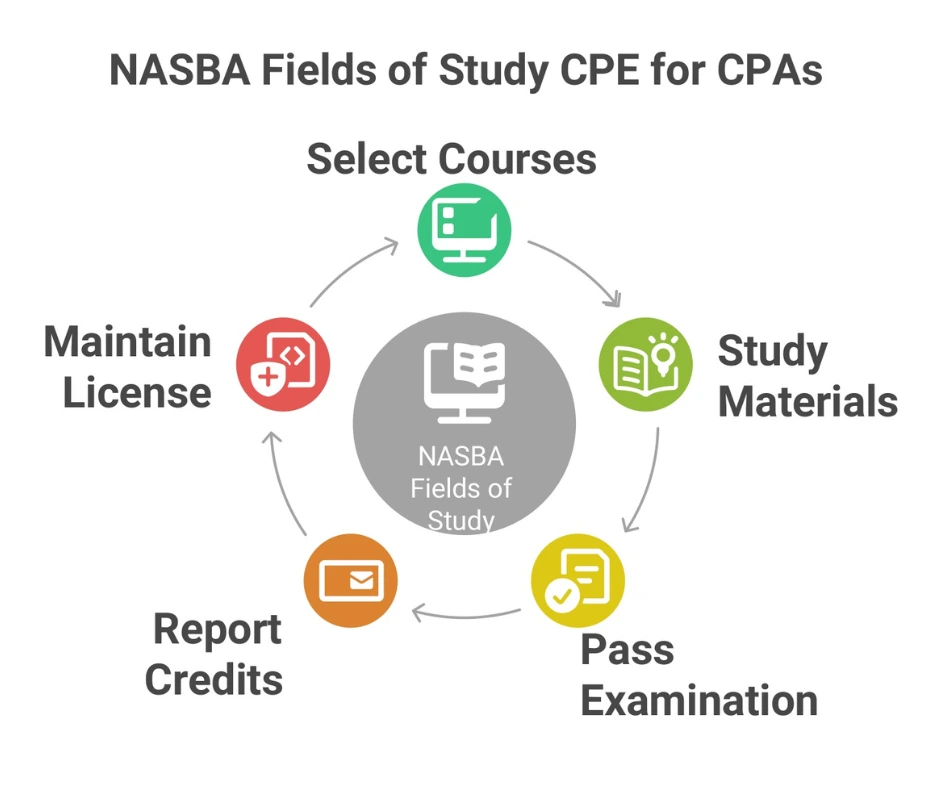
1. Who is this list of CPE courses for?This page is for CPAs, CFOs, and other accounting professionals who must meet CPE requirements, along with accounting firms and employers selecting training programs aligned with NASBA standards. 2. What is this list of CPE courses about or what problem does this course solve?The page explains the NASBA Fields of Study framework, which classifies CPE into 20 categories across two groups, Technical and Non Technical, helping professionals select courses that satisfy state board reporting requirements. | 3. Why is this list of CPE courses important to a CPA or Accountant?Understanding these fields supports compliance with state board CPE reporting, encourages balanced coverage of Technical and Non Technical subjects, and helps maintain professional credibility and competence. 4. When is this list of CPE courses relevant or timely?The information is relevant during CPE reporting periods, license renewals, periods of regulatory or framework revision, and when pursuing specialized knowledge to improve performance. | 5. Where can this list of CPE courses be found and accessed?These courses can be accessed online through the Cpethink.com platform, where learners can browse offerings classified under the NASBA Fields of Study. 6. How is a list of CPE courses like this consumed or used?Learners select courses aligned with the relevant field of study, study materials at their own pace, pass the final examination within one year of purchase, and report earned credits to their state board of accountancy. |
For any active CPA, CPE is the backbone of professional development. The NASBA Fields of Study serve as a structured framework for this. It has 20 categories, each comprising several subject matter areas. Your CPE credits need to fall under these areas.
If you want to maintain an active license, enhance professional competence, comply with your Board's regulations, and stay current with the evolving accounting profession, you must complete CPE in one of the NASBA Fields of Study.
This page will explore these fields, their practical applications, and why you should pursue your CPE, which is classified in the NASBA Fields of Study online.
This section will break down the framework into two main categories, along with their specific fields of study, helping you choose the courses that fall within NASBA Fields of Study.
These CPE learning activities directly relate to a CPA's field of business and the accounting profession. It covers 13 subject matter areas.
It covers a variety of subject areas such as, general accounting, accounting research, SSARs, FASB statements, IFRS, data analytics, forensic accounting, fraud, and more. You can apply this knowledge to analyze transactions, ensure transparency, and prepare accurate financial statements.
It helps you address the preparation or maintenance of financial records of governmental entities or contracts. Some related subject areas include GASB standards, ESG and Sustainability related to these entities or contracts, and forensic accounting related to them.
It focuses on independent examination services, risk assessment, and compliance. NASBA Fields of Study CPE courses in this subject matter prepare you to strengthen internal accounting controls, evaluate financial records to identify fraud, and build confidence in stakeholders. Some areas are general auditing, auditing research, ESG and Sustainability, SOC Reporting, and Forensic Analysis and Evaluation.
CPE in this NASBA Field of Study prepares you to perform systematic examinations of statements, records, and performances of governmental entities or contracts for specific purposes. Some related areas include Forensic Analysis and Evaluation pertaining to such entities or contracts, fraud related to them, and ESG and Sustainability related to them.
This equips you with knowledge of regulatory frameworks, contracts, and corporate governance. A strong understanding of legal principles helps you advise clients on acquisitions, mergers, and compliance issues. Some areas covered here are business laws, legal and tax issues, and employment laws.
This helps you gain insights into microeconomics, macroeconomics, public finance, and money and banking. Some areas include Economic Growth, Fiscal Policy, Banking Systems, Fundamentals of the International Economy, and Supply and Demand.
It encompasses corporate finance, risk management, and investment strategies. You can apply these skills to manage budgeting, valuation, and capital allocation. Budgeting and Cost Analysis, Asset Management, Financial Management, and Quantitative Analysis are some related topics.
CPAs need to understand IT systems to protect sensitive financial information and be able to use automation tools. This rapidly expanding field covers topics such as Artificial Intelligence, Cyber Security, Cloud Computing, Blockchain, Data Analytics, Robotics/Process Automation, and Disaster Recovery Plans.
It helps you stay compliant with professional codes of conduct like the AICPA Code of Professional Conduct. You must adhere to these standards to maintain public trust. Some subjects related to this field include Business Transactions with Clients, Conflict of Interest, Independence, Licenses and Renewals, and Integrity and Objectivity.
This field covers operations, strategic planning, and performance improvement. Topics like Performance Management, Cash and Treasury Management, Project Management, and Enterprise Risk Management help improve your services as a consultant.
It equips you with knowledge and skills for forecasting and decision-making. You can master topics like Analysis of Enumerative Data, Linear Models, Hypothesis Testing, and Analysis of Variance, etc. to predict financial outcomes, assess performance, and evaluate risk.
This field helps you serve diverse industries effectively. Some related topics are HIPAA Compliance, PCI Compliance, Brokers and Dealers in Securities, ESG and Sustainability, Energy Options on Futures, and Personal Financial Planning.
A cornerstone of accounting practice, this field prepares you to advise clients on tax compliance, planning, and strategies. Some related topics include Corporate Income Taxation, Individual Income Taxation, ESG and Sustainability, Compensation Considerations for Taxation, Real Estate Taxation, Partnership Taxation, and International Taxation.
These NASBA Fields of Study cover learning activities that are indirectly associated with a CPA's area of business. The 7 subject matter areas are:
You can use the knowledge in this field to avoid unethical practices and identify conflicts of interest. Understanding topics like Ethical Decision-Making, Personal Ethics, and Ethical Practice in Business helps you deliver professional services ethically.
Effective communication is vital for CPAs, whether making stakeholders understand complex financial statements, delivering presentations, or creating reports. Topics such as Business Presentations, Public Relations, and Business Writing help enhance your professionalism and competence.
This subject matter lets you gain the knowledge and skills to manage an organization. Some related topics are Administration of a Public Accounting Practice, Organization of a Public Accounting Practice, and Management and Strategic Planning in Business and Industry.
CPE courses in this NASBA Field of Study help accelerate your career growth by focusing on your personal and professional development, not just accounting topics. Some topics include Leadership, Career Planning, and Time Management. Do be aware that not all states accept CPE courses in this Field of Study
These NASBA Fields of Study CPE courses help you utilize computer software and applications when delivering professional services. Some subfields include how-to courses on Word, Excel, PowerPoint, and QuickBooks and courses related to ERP products.
This field addresses recruitment, workforce management, and employee relations, helping CPAs perform managerial roles effectively. These courses help you learn functional aspects of human resource management and how to build effective human resources management systems.
It's associated with production management, quality control, and cost efficiency. Some topics include Operations Management, Supply Operations, and Inventory Management.
These courses help you at every stage in your CPA career, because:
Additionally, employers can choose training programs for their CPAs based on their specific industry needs.
Here are the unique benefits of taking the online route to complete CPE courses in the NASBA Fields of Study.
Whether you want to focus on NASBA Fields of Study for accountants, NASBA Fields of Study for CPAs, or NASBA Fields of Study for CFOs, online programs are more cost-effective than conferences, in-person training, and webinars. These are designed to help you master both technical and non-technical fields of study within a reasonable CPE budget.
Another key benefit of these courses is that they give you complete freedom to cover the study materials at your own pace and earn the required credits. You just need to complete them and pass the final exams within one year of purchase.
This is designed for:
With a clear understanding of the fields of study, you can effectively plan your professional development and stay in good standing with your Board of Accountancy.
This page solves the problems of:
This page is always relevant to your career because CPE is an ongoing requirement for CPAs. It applies during:
The information related to NASBA Fields of Study applies throughout the United States. This is because all state boards of accountancy work with NASBA to manage CPA licensure. However, for CPAs outside the U.S. or working in multinational companies, understanding these fields is important when working with U.S.-based clients or MNCs.
You should prioritize the information on this page because the fields of study are closely tied to your professional credibility and compliance. For example, overlooking the importance of certain fields may lead to license suspension, penalties, or other disciplinary actions. Apart from compliance, a strong knowledge of them makes sure you remain ethical and competent in the quickly changing accounting landscape.
You can solve the above problems by:
NASBA Fields of Study provide you with a comprehensive roadmap for CPE. Mastering these fields isn't only about compliance; it's about staying ethical, competent, and building a resilient career. In short, they help transform CPE into a strategic advantage.

Check out what other customers are saying.






 Login/Register