0

Time Value of Money CPE: Mastering One of the Core Financial Principles |
| The Last Self-Study CPE Website You Will Ever Need (Click for Subscriptions) |
This page explains what Time Value of Money means, why it matters in finance and accounting, and how Time Value of Money CPE helps you apply it in practice.

The Time Value of Money (TVM) is at the heart of everything in finance, whether you're dealing with an individual's money or a business's capital. This fundamental financial principle states that a sum of money in your hands today has a greater value than the same amount in the future because of its potential earning capacity. You can invest it, earn returns, and watch it grow over time. If you're working in finance, whether personal or corporate, you need to get this concept inside out to guide clients toward smart financial and business decisions. That's where Time Value of Money CPE comes in.
Want to understand what CPE in Time Value of Money is all about? This piece covers everything you need to know and shows you how to get started.
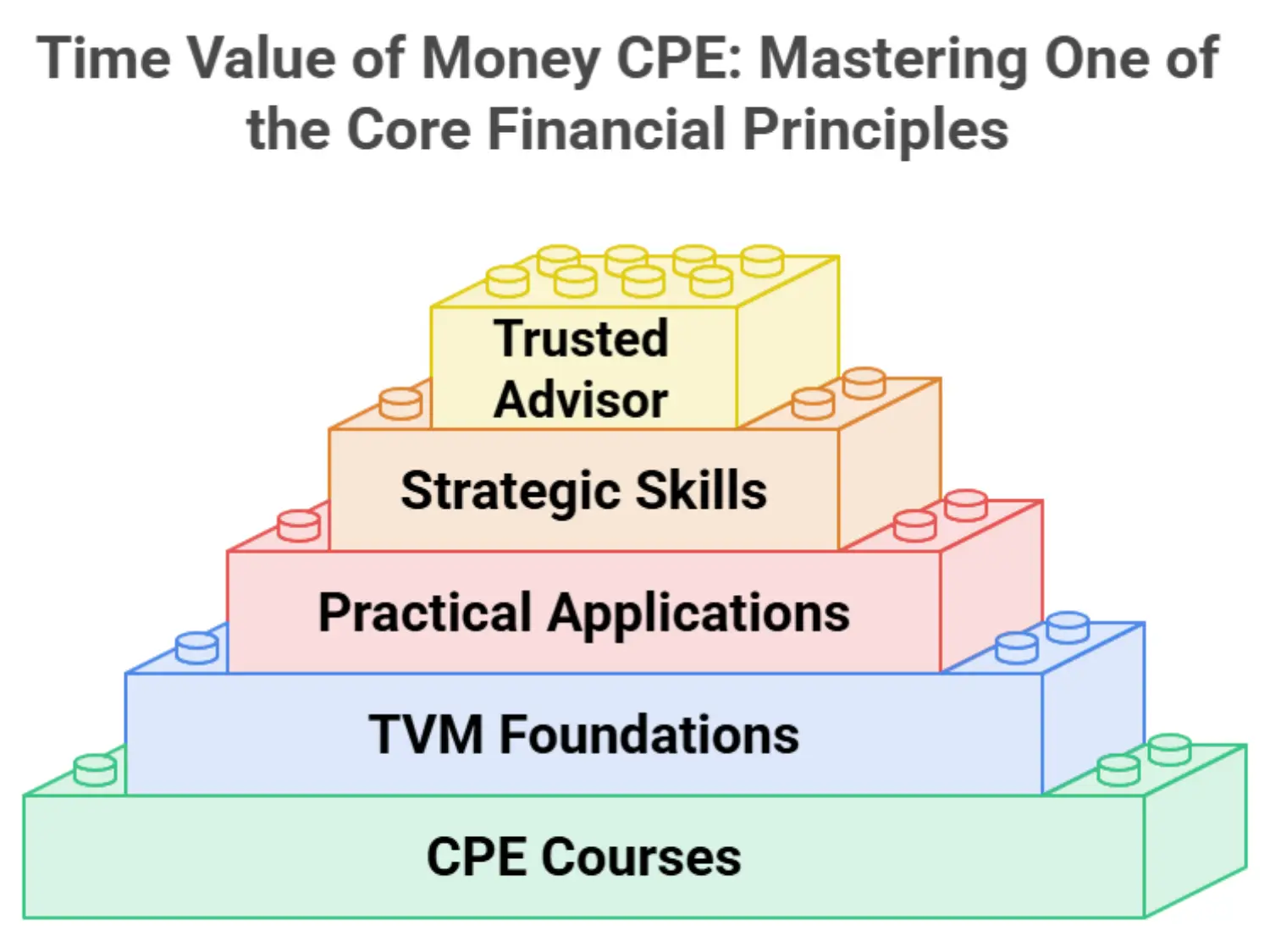
Time Value of Money CPE is a specific kind of continuing education for CPAs and other accounting professionals. In these courses, you dig into what the Time Value of Money really means, learn both the manual calculations and how to crunch the numbers in Excel, and work through real examples that actually come up on the job. The goal isn't just to help you handle financial statements accurately, it also sets you up to give smarter advice and help shape the bigger financial decisions that matter for individuals and businesses.
Time Value of Money (TVM) isn't just a theory you memorize to complete CPE courses and earn credits. Once you actually get the hang of it, you'll find it's everywhere in finance and accounting work. Here's how it plays out:
Companies don't just throw money at new projects. They have to decide which ones will actually pay off years down the line. That's where tools like Net Present Value (NPV) and Internal Rate of Return (IRR) come in. Analysts rely on these to check if a long-term project is worth the investment. Put simply: if the NPV is positive, it's likely a good deal for shareholders. Negative NPV? Probably a pass.
TVM pops up every time someone takes out a loan. Calculating monthly loan payments isn't just about dividing a total; you need to factor in both interest and principal and see how each payment chips away at the debt. The amortization schedule lays this out so borrowers know exactly how much they owe after each payment.
Whether it's a business weighing investment for expansion or an individual having a dilemma of renting vs. buying, TVM helps compare the risks and returns for each option. It gives a clear sense of what each choice is really worth in today's dollars.
TVM is essential for figuring out the real value of bonuses and long-term incentives that get paid down the road. Companies use it to decide how much money they need on hand now to meet promises they'll pay out in the future. Getting this right avoids surprises later.
When a business is deciding to lease or buy equipment or property, TVM steps in to compare the total costs over time. By discounting future cash flows, leaders can pick the option that uses their capital best and keeps long-term expenses down.
These aren't the only ways you'll use what you learn about TVM. Time Value of Money CPE also covers areas like creating savings plans for future goals and valuing and accounting for bond investments. By enrolling in the right courses, you'll see TVM woven into all sorts of financial decisions, big or small.
Today's accountants don't just keep the books straight. Clients expect you to bring real insights, vision, and advice that they can trust. CPE courses on Time Value of Money help you do exactly that. They don't just tick the continuing education box. They actually give you an edge, setting you apart from anyone who's only focused on the basics. By diving into these courses, you not only meet your CPE requirements, but you also build the practical skills that shape true leaders in finance and accounting.
Here's how Time Value of Money CPE courses can help:
CPE credits are a must for every active CPA, but these courses take you further. You learn to use Time Value of Money concepts correctly in financial reports, making sure everything lines up with GAAP and IFRS. It's not just about avoiding fines (though that matters). You're protecting the integrity of your clients' financial statements and guiding them through big, sometimes tricky decisions.
These courses give you tools to offer clients advice that really matters, especially when they're tackling major choices like capital investments, managing debt, or planning retirement. Time Value of Money training covers a lot of ground. Most importantly, it helps you clearly show clients why the timing of money matters, so they can make decisions with real confidence.
Let's face it: automation and AI are changing accounting fast. If you're a CPA or working in accounting, you need more than just number-crunching skills to stand out. Understanding Time Value of Money really sets you apart. You can help clients see which investments make sense, break down complicated cash flow problems, and give advice that actually matters. Clients trust you more when you offer insights they can't get from software alone.
A lot of the day-to-day accounting work is now handled by technology. Your value comes from what you add on top: judgment and strategy. Knowing TVM inside and out means you can check a computer's work, challenge shaky assumptions, and put financial models in the right context. In other words, you build skills that machines just don't have, like real-world knowledge, good judgment, and strategic thinking.
If you become an expert in TVM, you're not just helpful, you become an important asset to your organization and clients. You help individuals plan for long-term stability, and you advise business leaders through big decisions like funding projects or buying companies. It's the kind of expertise people look for in leaders, the ones who shape where a business is headed.
As the piece focuses on CPE in Time Value of Money, professionals who benefit the most from it are:
Whether you're guiding mergers and acquisitions, evaluating capital projects, or working with retirement portfolios, Time Value of Money CPE courses strengthen both your competence and credibility.
It helps you address the challenges of:
You can apply it in a variety of instances. For example, when:
Basically, whenever you determine a bond's fair value, plan retirement savings, or discount a lease obligation, you're applying TVM. Time Value of Money CPE keeps your skills sharp and aligned with the latest standards, making the knowledge relevant throughout your career.
TVM concepts apply across several domains. The key ones include:
Whether your interest revolves around Time Value of Money for CPAs or Time Value of Money for CFOs, the learning directly impacts your career trajectory, credibility, and relevance. When compliance is typically expected in the domain of finance and accounting, the ability to provide strategic insights is what differentiates you from your peers. You should read this piece because it helps you:
To navigate the challenges, you should:
Diving into Time Value of Money CPE isn't just another box to check. It's a smart move if you're serious about sharpening your skills. The right courses help you turn tricky TVM concepts into practical insights, so you're better at planning, more accurate in your work, and actually confident when you're giving advice. In short, if you want to stand out as a compliance pro or a trusted financial advisor, this is the kind of learning that gets you there.
If you want to get started, CPEThink.com has four affordable CPE courses on Time Value of Money, all created by seasoned authors. Take a look and see which ones fit what you need.
Bottom Content - Static -------------------------------------------------------------------------------

Check out what other customers are saying.







 Login/Register