Home
0
Home

Inventory CPE: A Comprehensive Guide for Accounting Professionals

The Last Self-Study CPE Website You Will Ever Need
(Click for Subscriptions)


Key Takeaway

This page explains what inventory CPE covers, why inventory accounting matters for compliance and financial reporting, and how to choose the right courses and sponsors.

  • Covers major areas including inventory valuation methods, lower of cost rules, impairment, disclosure requirements, and inventory auditing procedures.
  • Explains valuation approaches such as First In First Out, Last In First Out, weighted average cost, and specific identification.
  • Highlights features to look for in a quality course, including learning format options, real world examples, credit allocation, and course costs.
  • Outlines benefits such as professional credibility, career advancement, regulatory compliance, professional competence, and improved risk management.
  • Helps you identify who the content serves, including CPAs, auditors, CFOs, controllers, and financial analysts working with inventory accounting.
  • CPEThink.com offers three self study inventory CPE courses worth up to 16 credits, and is a NASBA QAS Self Study sponsor accepted in all U.S. states and territories and Canada.


Inventory CPE: A Comprehensive Guide for Accounting Professionals: Frequently Asked Questions (FAQs)

It covers inventory valuation methods and lower of cost rules, along with impairment, disclosure requirements, and inventory auditing procedures.

They teach First In First Out and Last In First Out methods, along with weighted average cost and specific identification approaches.

Look for a clear learning format and real world examples, along with proper credit allocation and reasonable course costs.

They build professional credibility and support career advancement, along with regulatory compliance and stronger risk management skills.

CPEThink.com offers three self study inventory CPE courses, worth up to 16 credits combined.

Yes, as a NASBA QAS Self Study sponsor, their courses are accepted in all U.S. states and territories and Canada.

Inventory CPE: A Comprehensive Guide for Accounting Professionals


Item Types:
Field of Study:
Authors:
CPE Hours:
Keyword:
Records per page:
All Items
Records per page:


Efficient inventory management is one of the most critical aspects for any business that depends on the acquisition, storage, and sale of goods to generate revenue. The way it handles its inventory significantly impacts cash flow, profitability, compliance, and long-term growth. In short, the better its management is, the clearer the picture everyone gets of the business's performance and financial health. Proper inventory management is directly tied to inventory accounting, which is inherently complex. This is where the value of professionals with robust knowledge of inventory accounting becomes paramount. So, for CPAs and other accounting professionals, inventory CPE can be a significant advantage.

Inventory CPE courses equip them with the technical knowledge and practical skills to navigate evolving accounting standards, strengthen audit procedures, and maintain compliance with regulatory requirements. This comprehensive guide aims to provide all the information you need to complete CPE in inventory efficiently.
Inventory CPE Explained

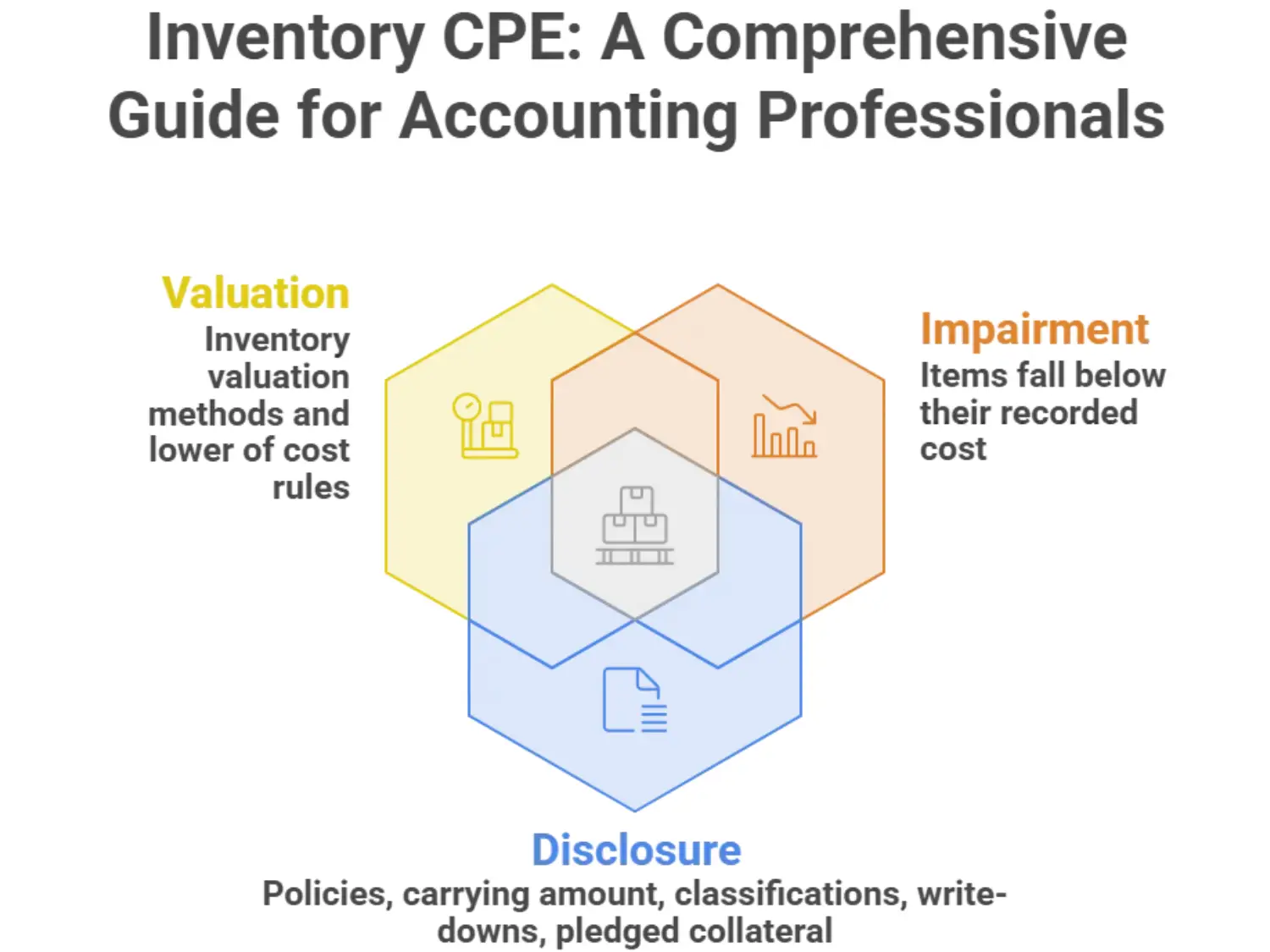
Inventory CPE courses for CPAs covering inventory valuation methods, lower of cost rules, impairment, disclosures, and inventory auditing

Inventory CPE is a specialized field of professional learning for CPAs and other accountants and finance professionals. Going beyond the fundamentals of inventory management, inventory CPE online and in-person courses focus on the technical, regulatory, and compliance aspects. These structured educational programs let you earn CPE credits while mastering inventory accounting and auditing procedures.

Inventory CPE Courses: Key Areas Covered

As inventory is among the largest and most complex asset categories, these courses usually cover a broad range of technical and practical topics. Here are the major areas in detail:

Inventory Valuation Methods

  • First-In, First-Out: The FIFO method assumes the oldest inventory products are sold first. It often leads to higher reported profits because older inventory is typically cheaper when prices are rising.
  • Last-In, First-Out: The LIFO method assumes the newest inventory products are sold first. During periods of increasing prices, this often results in higher COGS (Cost of Goods Sold) and lower taxable income. Note that it's prohibited under IFRS but allowed under U.S. GAAP.
  • Weighted Average Cost (WAC): It spreads costs evenly across all items in inventory. It's useful for bulk commodities.
  • Specific Identification Method: It matches a specific product's exact purchase cost with the revenue generated when it's sold.

Lower of Cost Rules

  • Lower of Cost or NRV: It records inventory at whichever is lower between the Cost and the Net Realizable Value.
  • Lower of Cost or Market (LCM): It records whichever is lower between the actual cost and the "Market" value.

Impairment

  • Impairment: Occurs when the value of items falls below their recorded cost. A few common reasons are obsolescence, physical damage, and market shifts.

Disclosure Requirements

  • This is the mandatory reporting of accurate financial information. Companies must report their accounting policies, carrying amount of inventories, inventory classifications, write-downs, and pledged collateral.

Inventory Auditing

  • Risk assessment: Inventory is typically prone to misstatements because of valuation errors, impairment, or fraud. CPE courses in inventory auditing help you acquire the knowledge and skills necessary to spot the red flags and take preventive measures.
  • Internal controls: You learn how to build a robust inventory tracking system, minimizing the need for manual intervention and streamlining tracking processes.

Mastering these areas ensures you're well-equipped to handle the real-world challenges of inventory accounting in diverse industries, while letting you stay compliant with CPE requirements.

Key Features of CPE Courses in Inventory

Are you thinking about taking courses on inventory for accountants, or programs focusing on inventory for CPAs, or inventory for CFOs? Irrespective of your specific objective, you should ensure they have these key elements.

Learning Format

  • Enroll in inventory CPE online courses if you want to learn at your own pace. Note that you must complete the final exam with a minimum score of 70%.
  • Webinars are ideal for professionals who prefer to learn in a virtual classroom-like setting.
  • Although typically more expensive, in-person seminars/conferences provide great opportunities for face-to-face interaction with other accounting professionals and expanding your professional network.

Real-World Examples & Interactive Elements

  • Case studies that help you learn how to apply inventory accounting techniques in practical scenarios.
  • Elements like disclosure drafting tasks or simulated audit procedures help deepen your understanding of various rules and methods.

Credit Allocation

  • Each hour (50 minutes) of learning in an approved learning activity is equivalent to one CPE credit.
  • CPE requirements vary by state and reporting period, so you should plan inventory CPE while keeping the requirements related to other fields of study in mind.

Course Costs

  • These vary heavily from one provider to another. Self-study CPE courses in inventory are more cost-effective than live seminars and conferences. For these courses, you should choose a NASBA QAS Self-Study sponsor like CPEThink.com. As a NASBA QAS Self-Study sponsor our courses are accepted by all U.S. states and territories and Canada.
  • If you want to stick to one provider to meet all or most of your CPE requirements, it's best to buy a CPE subscription.

Top Benefits of Completing CPE in Inventory

Completing inventory CPE courses offers an array of advantages. The primary ones include:

Professional Credibility

  • Demonstrates your mastery of one of the most difficult areas of accounting, leading to enhanced professional reputation.
  • Employers and clients may prefer professionals who stay current with the latest rules and regulations and are committed to staying competent throughout their career.

Career Advancement

  • The right courses strengthen expertise in managing inventory accounting procedures, helping you stand out in a competitive job market.
  • Specialized knowledge in inventory often opens the door to senior positions.

Regulatory Compliance

  • When you must earn a certain number of CPE credits each reporting period, CPE in inventory helps you fulfill the non-technical or technical requirements, depending on the course.
  • Ensures you're prepared for external audits and regulatory inspections.
  • Helps you apply U.S. GAAP and IFRS rules correctly, minimizing the risk of non-compliance.

Professional Competence

  • The ability to navigate differences between IFRS and U.S. GAAP prepares you to work with multinational companies.
  • Demonstrates your adaptability to employers and clients, enhancing your employability worldwide.

Risk Management

  • Programs developed by experts equip you to spot and prevent manipulation in inventory accounting procedures.
  • Helps you minimize mistakes that may distort financial statements.
  • Improves your ability to design and implement strong internal controls, strengthening risk management and improving overall operational efficiency.

Who Does This Guide Help?

This knowledge base is for:

  • CPAs looking for in-depth information on inventory CPE.
  • Auditors who need specialized training in inventory accounting.
  • CFOs and controllers who are responsible for accurate financial reporting and compliance.
  • Financial analysts trying to decide on the right inventory CPE courses based on their professional responsibilities.
  • Aspiring accounting professionals who want to specialize in inventory procedures and need to know how CPE in inventory helps them achieve that goal.

What Problems Does This Guide Solve?

It helps you solve the problems of:

  • Keeping up with the evolving inventory accounting and auditing standards.
  • Non-compliance with reporting standards and your BoA's CPE requirements.
  • Selecting the right courses to learn the best practices for building effective inventory tracking systems.
  • How to develop a strong understanding of different frameworks (U.S. GAAP vs. IFRS) when your company needs to comply with multiple standards simultaneously.

When Is This Information Relevant?

In-depth information on inventory CPE is especially relevant when you:

  • Must obtain credits within your CPE reporting period.
  • Need to conduct year-end audits accurately.
  • Must stay current with the latest GAAP and/or IFRS standards.
  • Are trying to move into a higher position and need high-quality, inventory-focused training.
  • Are working with multinational organizations or handling cross-border reporting.

Where Can You Apply the Information Acquired from This Guide?

You can apply it:

  • In both the United States (when using U.S. GAAP standards) and internationally (when using IFRS standards).
  • In various corporate settings that heavily focus on inventory management.
  • In audit firms that conduct substantive testing and risk assessment.

Why Do You Need This Guide?

This guide provides comprehensive information about CPE in inventory, which is essential for:

  • Earning CPE credits without which you may face disciplinary actions.
  • Accelerating career growth by completing specialized inventory CPE courses.
  • Demonstrating your expertise and your commitment to maintaining excellence to employers, clients, and stakeholders.
  • Getting prepared to work in a global context.

How Does the Information Help You Solve the Problems?

  • Enroll in inventory CPE online courses from a top-rated, NASBA QAS self-study provider like CPEThink.com.
  • Choose appropriate courses based on your present requirements and future career goals.
  • Clear the final exams on time with at least 70% score to get your credits.
  • Use the newly acquired knowledge and skills to improve tracking processes, valuation methods, audit procedures, and disclosure practices.
  • Refresh skills whenever GAAP and IFRS standards evolve.
  • If possible, tailor the learning to the specific industry you're currently working in or planning to join in the near future.

Conclusion

Inventory CPE is a professional necessity rather than just a box to tick for compliance. It helps you master inventory accounting and auditing standards, enhancing your ability to manage one of the most risk-prone and complex areas of financial reporting. By completing quality inventory CPE courses, you position yourself not just as a competent accounting professional, but also as a trusted advisor capable of guiding organizations through the complexities of a globalized business environment.

If you want to start right away, enroll in CPEThink.com's three inventory CPE online courses. Developed by experienced professionals, these programs let you earn 2 to 16 credits at affordable price points.


seperator


Check out what other customers are saying.


Home > Inventory Cpe
Thank you for taking one of our free courses. We would like to be able to let you know when we add free courses or have special offers and will never spam you or share your address with anyone. If you are Ok with that please reply with "Ok" or if not please reply "No Thanks". Either way enjoy your free CPE course.
  
Exam completed on .

Do you want to add the course again?