Home
0
Home

Accounts Payable CPE: Helping You Build Skills That Elevate Your Career

The Last Self-Study CPE Website You Will Ever Need
(Click for Subscriptions)


Key Takeaway

This page explains what accounts payable CPE covers, the real world benefits it provides, and how to choose the right accounts payable CPE courses.

  • Covers key areas including internal controls, accounts payable automation, cash flow optimization, regulatory updates, ethics, AP analytics, and vendor management.
  • Helps you maintain professional certifications such as CPA, CIA, or CMA while building skills to manage accounts payable functions.
  • Provides real benefits including professional credibility, career progression, operational efficiency, risk mitigation, and strengthened ethical standards.
  • Recommends choosing courses based on accreditation, specialization, flexibility, cost effectiveness, format, and practical application.
  • CPEThink.com is a NASBA QAS Self Study sponsor whose courses are accepted in all U.S. states and territories and Canada.
  • CPEThink.com offers accounts payable CPE courses ranging from $17.95 for 2 credits to $119.95 for 15 credits.


Accounts Payable CPE: Helping You Build Skills That Elevate Your Career: Frequently Asked Questions (FAQs)

It covers internal controls, AP automation, and cash flow optimization, along with regulatory updates, ethics, analytics, and vendor management.

Accounts payable CPE helps maintain certifications such as CPA, CIA, or CMA.

It provides professional credibility, career progression, and risk mitigation, along with operational efficiency and stronger ethical standards.

Evaluate courses based on accreditation, specialization, and flexibility, as well as cost effectiveness, format, and practical application.

Yes, as a NASBA QAS Self Study sponsor, CPEThink.com courses are accepted in all U.S. states and territories and Canada.

Courses range from $17.95 for 2 credits to $119.95 for 15 credits.

Accounts Payable CPE: Helping You Build Skills That Elevate Your Career


Item Types:
Field of Study:
Authors:
CPE Hours:
Keyword:
Records per page:
All Items
Records per page:


If your business buys anything on credit, keeping a close eye on accounts payable isn't just a box to check. It's key to managing your cash flow, guarding against errors and fraud, keeping solid vendor relationships, and making sure your financial reporting is accurate. Accounts payable usually happens quietly in the background, but it takes knowledge, a variety of skills, and meticulous attention to do it right. For professionals in accounting and finance, handling accounts payable means always learning and sharpening new skills. That is precisely where the importance of accounts payable CPE comes into the picture.

In this article, we'll dig into why accounts payable CPE courses matter, what topics they mainly cover, the real benefits they deliver, and how you can pick the best ones to help push your career forward.
Accounts Payable CPE Explained

Accounts payable CPE courses for CPAs covering internal controls, AP automation, cash flow, vendor management, and ethics

CPE in accounts payable refers to the structured learning programs that help finance and accounting professionals hone their skills in managing accounts payable functions while completing hours required to maintain professional certifications such as CPA, CIA, or CMA.

Fundamentally, accounts payable CPE courses provide you with the skills and knowledge to navigate the challenges associated with one of the most risk-prone and complex areas in accounting.

Key Areas Covered in Accounts Payable CPE Courses

CPE courses in accounts payable help you learn much more than the fundamentals of invoice processing. They provide advanced knowledge in complex areas that directly impact efficiency, risk management, and compliance.

Here are the key topics commonly covered in accounts payable CPE online or offline programs.

Internal Controls

  • Helps you learn how to build strong frameworks to prevent errors, duplicate payments, and fraud.
  • Teaches how to segregate duties, approval hierarchies, and audit trails.
  • Related programs often have case studies highlighting real-world fraud incidents and let you learn how they could have been prevented with strong internal controls.

Accounts Payable Automation

  • Focuses on how technology such as AI, ERP systems, and Robotic Process Automation can streamline AP workflows and make them efficient.
  • Helps you learn about digital payment platforms, automated approvals, and electronic invoicing.
  • Helps you choose the right automation tools according to your organization's needs.

Cash Flow Optimization

  • Allows you to master strategies to align AP practices with cash flow management and treasury management as a whole.
  • Teaches about vendor financing, dynamic discounting, and early payment discounts.
  • Explores how to balance liquidity with vendor satisfaction.

Regulatory Updates

  • Helps you stay current with the latest accounting standards, tax laws, and reporting requirements.
  • Teaches GAAP, IFRS, and other compliance frameworks.
  • Teaches how to handle cross-border payments and international tax obligations.

Ethics in Accounts Payable

  • Helps you maintain transparency and professional integrity in the processes.
  • Provides guidance on handling ethical dilemmas such as unauthorized payments or favoritism in vendor selection.
  • Encourages compliance with professional codes of conduct and upholding organizational values.

AP Analytics and Reporting

  • Focuses on how to use data to improve AP-related decision-making processes.
  • Teaches you methods to track KPIs.
  • Provides a strong understanding of dashboards and reporting tools that offer real-time visibility.

Vendor Management

  • Focuses on building and maintaining strong, compliant relationships with vendors.
  • Helps you master onboarding procedures, contract compliance, and dispute resolution strategies.
  • Prioritizes clear communication and transparency to avoid late payments or strained relationships.

Real-Life Benefits of CPE in Accounts Payable

Completing accounts payable CPE offers several advantages for individual professionals and the companies they work for. These include:

Professional Credibility

  • Compliance with CPE requirements demonstrates your commitment to ongoing learning and improving professional competence.
  • Employers may regard professionals who prioritize CPE in accounts payable as more knowledgeable and reliable than those who overlook its importance.

Career Progression

  • Completing accounts payable CPE courses boosts your resume, signaling expertise in the complex area.
  • These courses help position yourself for leadership roles, promotions, and consultancy opportunities.

Operational Efficiency

  • Courses taken from a credible CPE provider help you master the key areas mentioned above, improving your efficiency. For example, automation-focused programs significantly help reduce workload and errors.

Risk Mitigation

  • The AP function is highly vulnerable to operational errors. CPE courses help you gain the knowledge and skills necessary to avoid errors such as duplicate payments and late payments. You minimize these risks through process improvements, audit trails, and automation.
  • AP is a frequent target for vendor impersonation and invoice fraud. Accounts payable CPE online or in-person programs teach you how to identify red flags such as unusual vendor requests, modified payment details, or duplicate invoices.
  • AP processes require strict compliance with regulatory frameworks like GAAP, IFRS, and tax laws. With CPE programs, you keep abreast of the latest regulations, ensuring adherence to all applicable guidelines.

Ethical Standards

  • Accounts payable CPE reinforces the importance of transparency and integrity in AP processes.
  • Programs often include case studies on ethical dilemmas, helping you navigate complex, real-life situations.

Organizational Benefits

  • From an organizational standpoint, these courses help strengthen the entire finance department's ability to handle AP processes.
  • Organizations benefit from improved compliance, minimized fraud risk, and strong vendor relationships.

Choosing the Right CPE Courses in Accounts Payable

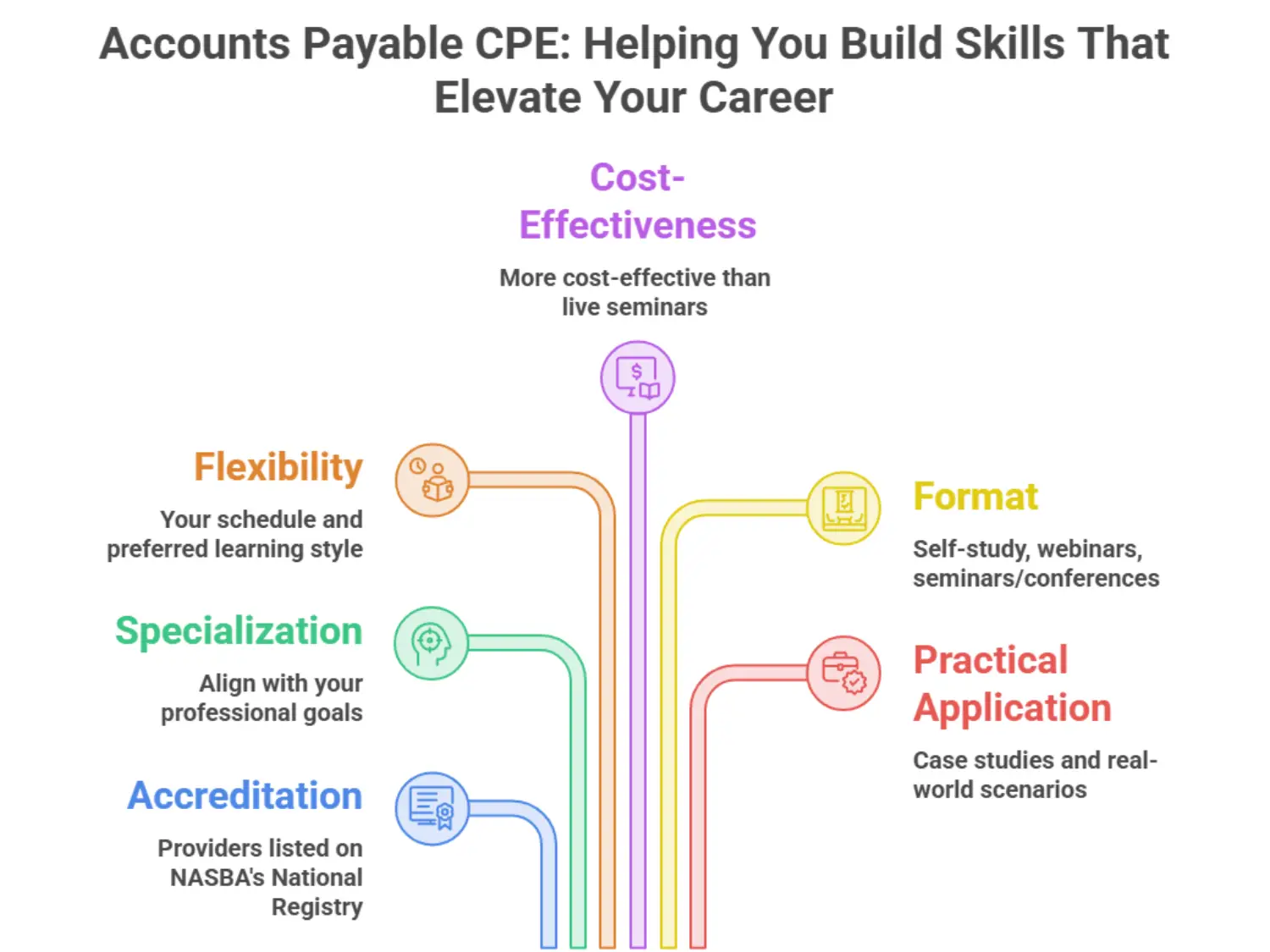
Selecting the right accounts payable CPE courses is paramount for improving professional competence and maximizing organizational impact. With lots of options available, you should evaluate programs based on accreditation, specialization, flexibility, cost-effectiveness, format, and practical application.

Accreditation

  • Make sure the programs are offered by providers listed on NASBA's National Registry of CPE Sponsors.
  • As a NASBA QAS Self-Study sponsor our courses are accepted by all U.S. states and territories and Canada.

Specialization

  • Select courses that align with your professional goals and/or organizational needs.
  • For example, if you want to specialize in fraud detection, you may want to take courses that teach areas related to internal controls, segregation of duties, and audit trails.

Flexibility

  • Consider your schedule and preferred learning style.
  • Many CPAs choose accounts payable CPE online courses because they can be completed at your own pace, offering maximum flexibility.

Cost-Effectiveness

  • Many CPAs find it difficult to manage their CPE budget as they need to earn many credits apart from the ones in accounts payable CPE.
  • Online CPE courses in accounts payable are more cost-effective than live seminars and conferences.

Format

  • Self-study programs are ideal for independent learners.
  • Webinars are perfect for those who prefer interactive, real-time learning.
  • Seminars/conferences are ideal for those who prefer face-to-face interaction and want to utilize networking opportunities.

Practical Application

  • Select programs that discuss case studies and emphasize real-world scenarios.
  • This helps you apply the knowledge to your regular tasks and responsibilities.

Careful evaluation of these factors helps make sure that not only can you meet your CPE requirements, but you can also gain skills and knowledge that directly improve your competence and make you highly valuable in the organization.

At CPEThink.com, we currently offer several accounts payable CPE courses, ranging from $17.95 (2 credits) to $119.95 (15 credits). Whether you want to learn accounts payable for CPAs, accounts payable for CFOs, or accounts payable for accountants, these courses cover the core areas discussed above.

Who Does This Article Help?

This article is created primarily for:

  • CPAs who want to complete accounts payable CPE and need in-depth information about it.
  • Professionals working in accounting or finance departments aspire to be accounts payable specialists through quality education.
  • Professionals who want to know how accounts payable CPE courses can accelerate their career growth.
  • CPAs and other professionals who need to choose credible CPE providers.

What Problems Can You Solve with It?

The information shared in this article helps you navigate the challenges of:

  • Understanding how CPE courses in accounts payable help you master different areas of AP processes.
  • Overcoming career stagnation through specialized training in accounts payable.
  • Improving professional competence and operational efficiency by selecting the right CPE courses.
  • Maintaining your CPE budget while still receiving quality training in AP.

When Can You Apply This Information?

You can apply the knowledge gained from this article to various situations. For example:

  • When fulfilling CPE requirements, and you want to hone your skills in certain AP processes.
  • During changes in accounting standards or tax laws, and you need to complete courses from credible CPE providers.
  • During organizational growth, when you need to update skills in specific AP-related areas.

In short, this information is relevant whenever you need to stay compliant and efficient.

Where Does This Information Apply?

Accounts payable CPE applies to a variety of sectors. For example:

  • Any organization that buys goods or services on credit and must handle AP processes efficiently.
  • Public accounting firms that advise clients on best AP practices.
  • Nonprofits that need to manage donor funds and vendor contracts.
  • Multinational companies that deal with cross-border payments and indirect taxes.

Why Should You Have This Information?

With this information, you can:

  • Remain compliant with your Board's CPE requirements.
  • Improve your knowledge and skills in certain AP processes based on your professional requirements and personal preferences.
  • Position yourself for leadership roles and promotions.
  • Make sure your organization benefits from compliance with regulatory frameworks, effective cash flow management, and strong vendor relationships.

How Can You Solve the Problems Using the Information in This Article?

You can solve the above challenges by:

  • Choosing a NASBA QAS Self-Study sponsor. As a NASBA QAS Self-Study sponsor our courses are accepted by all U.S. states and territories and Canada.
  • Selecting and completing the right accounts payable CPE courses based on your requirements.
  • Choosing the right learning format based on your schedule and learning style.
  • Enrolling in courses that cover the latest regulatory changes.

Wrapping Up

Pursuing accounts payable CPE helps you tailor your learning to one of the most important areas in an accountant's career. Whether you want to master compliance, cash flow, fraud prevention, vendor management, ethical practices, or analytics, the right courses help ensure you remain technically skilled and your learning is aligned with your long-term career goals.


seperator


Check out what other customers are saying.


Thank you for taking one of our free courses. We would like to be able to let you know when we add free courses or have special offers and will never spam you or share your address with anyone. If you are Ok with that please reply with "Ok" or if not please reply "No Thanks". Either way enjoy your free CPE course.
  
Exam completed on .

Do you want to add the course again?