0

Your Handbook on the Wisconsin Accounting Examining Board |
| The Last Self-Study CPE Website You Will Ever Need (Click for Subscriptions) |
This page explains the Wisconsin Accounting Examining Board, including its history and structure, CPA licensure pathways, continuing education requirements and accommodations, reciprocity, and enforcement of professional conduct rules, to help Wisconsin CPAs and candidates stay compliant.

Trust sits at the heart of the accounting world. Every entity, from government agencies to businesses and individuals, relies on accountants to keep financial reports accurate, give solid advice, and carry out independent audits people can believe in. In "The Badger State," the Wisconsin Accounting Examining Board keeps that trust alive. They make sure accountants stick to ongoing education and professional standards, which keeps people's faith in the state's financial systems intact.
If you're an experienced CPA or just starting out in accounting, you need to know what the Wisconsin State Board of Accountancy (Accounting Examining Board) does. This handbook walks you through the board's history, how it's set up, what it's responsible for, and details about continuing education. You'll find what you need to stay on top of the Wisconsin CPA license renewal process and keep growing as a professional in Wisconsin.
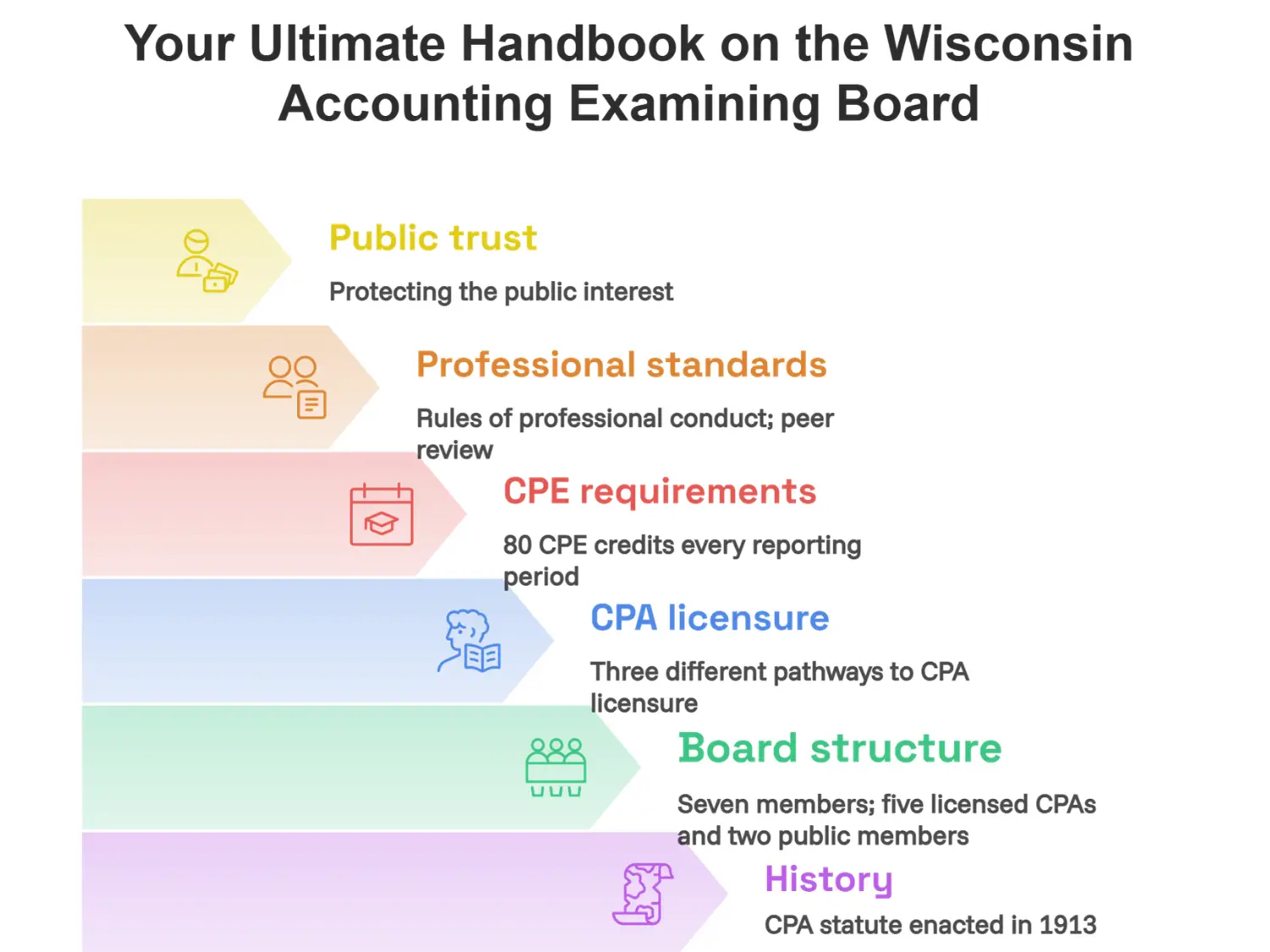
Being the regulatory body for the practice of accountancy within the state, the Wisconsin Department of Public Accountancy (Accounting Examining Board) handles several functions. Each one is aimed at maintaining public trust in the profession and ensuring practitioners meet professional and ethical standards.
Here's a breakdown of its primary responsibilities.
Granting CPA licenses to eligible candidates is one of the primary responsibilities of the Wisconsin Accounting Examining Board. From reviewing applications and verifying educational credentials to making sure that candidates fulfill experience requirements, it oversees the entire pathway to becoming a Wisconsin CPA. With the enactment of 2025 Wisconsin Act 166, the Board now handles three different pathways to CPA licensure.
Across all pathways, candidates must pass the Uniform CPA Exam and a state-specific ethics exam (open-book).
To maintain an active license in the state, CPAs must meet all Wisconsin State Board of Accountancy CPA requirements. These requirements ensure that CPAs stay up-to-date with the latest regulations, standards, and industry practices. The Board accepts CPE activities that meet its criteria, and CPAs must keep documentation of each activity for at least 5 years.
Under Wisconsin Administrative Code's Chapter Accy 1, the BoA enforces rules of professional conduct. As per these rules, CPAs must maintain independence, act with integrity, avoid conflicts of interest, and adhere to strict accounting and auditing standards. In the occurrence of professional misconduct, the Wisconsin Board of Accountants investigates complaints and may impose disciplinary measures, such as a reprimand, probation, suspension, additional education, or revocation of license. Visit this page to read the full text of these regulations.
Beyond individual Wisconsin CPAs, the Board regulates public accounting firms operating in the state. They must get a firm license from the Board, comply with naming conventions, and fulfill ownership requirements.
The Peer Review Program of the Wisconsin Accounting Examining Board is a mandatory requirement for CPA firms that perform audits, reviews, compilations, or other attest services. The quality-assurance program evaluates the quality control systems and professional competency of CPA firms to make sure they adhere to professional standards. To renew their license, those firms must undergo a peer review at least once every three years and provide peer review documents to the Board when it requests them.
It allows CPAs whose principal place of business is outside Wisconsin, and who hold a valid license from another state with similar requirements, to practice in Wisconsin without a Wisconsin license. In doing so, they agree to the Board's jurisdiction, discipline, and rules.
If you have an active CPA license in another jurisdiction, you may become a Wisconsin Certified Public Accountant by satisfying certain licensing criteria. The Board permits endorsements for international candidates also.
To apply by endorsement, you must have an account in the Wisconsin LicensE Portal and process your application through it.
The Wisconsin State Board of Accountancy sets ethics and professional conduct policies for practitioners.
To set practical standards for the accounting profession, the regulatory body drafts, reviews, and makes modifications to administrative rules. These rules must be complied with by CPAs and CPA firms within the state.
Protecting the public interest is a core responsibility of the Wisconsin Accounting Examining Board. Through strict oversight, it safeguards consumers, businesses, investors, and other stakeholders that depend on accurate financial information. Anyone can use the Wisconsin State Board of Accountancy license lookup tool (also known as the Wisconsin CPA license search tool) to verify the credentials of a CPA or accounting firm.
For Wisconsin CPA license renewal, you must meet these requirements:
This helps:
This helps solve the problems of:
It also helps the public stay assured of the competence of CPAs or accounting firms they hire.
As CPAs must comply with the Board's guidelines throughout their careers, this information is always relevant. Some instances of relevance are:
It primarily applies to "The Badger State," as the Board regulates the practice of public accountancy here. It's also applicable to other states when you need to follow Wisconsin's reciprocity and endorsement policies.
You should care because:
Note that when searching for the Board's portal online, use its full form, as the acronym of the Wisconsin Accounting Examining Board (AEB) and ASBPA may be confusing. The latter stands for the "Alabama State Board of Public Accountancy" or the "Arkansas State Board of Public Accountancy."
We hope that now you have a strong comprehension of the key responsibilities and CPE requirements of the Wisconsin Accounting Examining Board and how to address the challenges that may crop up during your effort to meet them.
If you're looking for CPE courses to fulfill these requirements, check out our course catalog today!

Check out what other customers are saying.



 Login/Register