0

State Boards of Accountancy List: A Guide to Nationwide CPA Licensing Authorities |
| The Last Self-Study CPE Website You Will Ever Need (Click for Subscriptions) |
This page explains how state boards of accountancy regulate CPAs and CPA firms across the 55 U.S. jurisdictions, covering their core licensing and oversight functions, how they adapt to changing compliance demands, and their broader role in shaping the accounting profession.

Competence, accountability, and trust are central to the accounting profession. Every audit, tax filing, and financial report depends on the reputation of CPAs, and that reputation rests on state boards of accountancy setting the requirements for who is licensed and how they keep a license.
This state boards of accountancy list isn't just a directory of accounting licensing agencies. This guide explains how state boards oversee the profession. They make sure every CPA meets education, experience, examination, and ethics requirements before a license is issued. After licensure, CPAs must complete continuing education to keep the license active.
Together, these boards protect the public and support confidence in financial reporting.
So, whether you're a U.S. CPA or just sorting out your first U.S. CPA license, this list gives you an overview of how the boards regulate the profession, adapt to new rules, and shape its future.
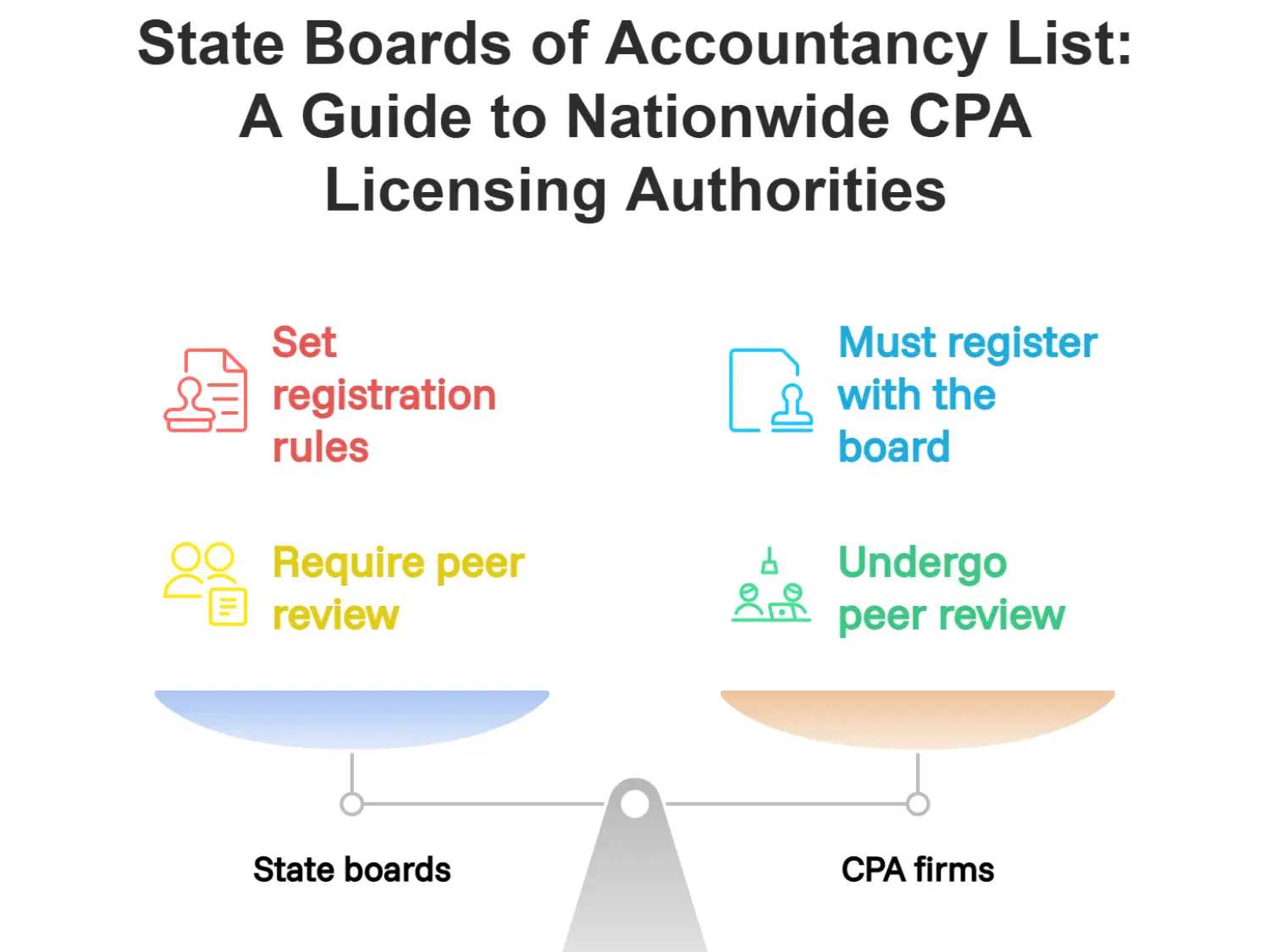
Licensing is a core board function. Boards make sure only qualified people become U.S. CPAs by checking academic records, confirming work experience under the right supervision, and making sure the applicant passes the Uniform CPA Exam. When it comes to ethics, many states require you to pass the AICPA's ethics exam. But some states add their own ethics courses or exams, while a few don't ask for a separate pre-licensure ethics test at all. Each state board sets its own requirements under its state's laws.
Accounting licensing agencies don't just oversee individual CPAs; they keep an eye on CPA firms, too. They set registration rules to make sure any firm offering services meets professional standards. Many boards also require firms that perform certain services, such as audits and other attest work, to undergo peer review.
These boards also update their rules to match national standards. Most state boards have adopted the AICPA Code of Professional Conduct in their state accountancy laws or have written their own ethics rules.
Apart from regulating the accounting licensing process for both individuals and firms, the state boards of accountancy investigate complaints from employers, clients, and the public. These can be triggered by allegations of negligence, fraud, or ethical violations. Disciplinary actions range from reprimands and fines to suspension and revocation of licenses. This power deters CPAs from misconduct while reinforcing accountability.
All active U.S. CPAs must complete a set number of CPE hours every reporting period as per the guidelines set forth by their respective boards. While these requirements vary from one jurisdiction to another, they typically include ethics courses, whether general or state-specific or both. Some boards also have minimum and maximum credit hour thresholds for technical and non-technical subject matters, respectively.
Rules for CPAs change as new laws, technologies, and public expectations emerge. State boards of accountancy update their requirements so accountants follow current standards.
Here's how they do it:
Boards interpret and integrate updates from many sources, including federal agencies like the IRS and SEC, groups such as the PCAOB, and international standards setters. They update rules, issue guidance, and align state requirements with national frameworks, so CPAs work with consistent standards.
These days, compliance and technology go hand in hand. Boards now rely on online portals for things like licensure applications, renewals, and keeping up with continuing education. If a state board participates in NASBA's CPE Audit Service, licensees can report and track their CPE in one place. These systems reduce paperwork and make compliance easier to track.
CPAs often practice in more than one state. The Uniform Accountancy Act (UAA), a model licensing law published by the AICPA and NASBA, gives state legislatures and boards a national model they can adopt as is or adapt, providing a uniform approach to regulation, including CPA mobility. Boards put these rules into practice in their own jurisdictions.
Public trust depends on ethical behavior. Most boards require ethics CPE as part of license renewal, and they discipline CPAs who violate ethics rules.
As financial markets go global, NASBA and the AICPA, through the International Qualifications Appraisal Board (IQAB), maintain mutual recognition agreements with professional accountancy bodies in other countries. These agreements let qualified accountants from those countries practice in the U.S. without completely re-credentialing, and give U.S. CPAs similar recognition in those countries.
Accounting licensing agencies also influence the profession's direction. Their decisions affect how CPAs work, how much the public trusts them, and how they adopt new technology.
Boards protect public confidence in the profession. They set ethical standards and take action when those standards are violated, so the public can rely on CPAs as advisers.
Board oversight continues after licensure. Boards set the rules for continuing education, so CPAs keep up with new laws and technology.
Boards are active participants in shaping the regulatory environment. Through NASBA, they work with the AICPA on the Uniform Accountancy Act, the model law that state legislatures and boards can adopt or adapt.
As the state boards of accountancy serve several entities, this guide helps:
This state boards of accountancy list provides you with a holistic view of the entire system, helping you solve the problems of:
It's relevant throughout the entire lifecycle of a U.S. CPA's professional journey. For example:
This state boards of accountancy list applies to all 55 jurisdictions: 50 states along with Puerto Rico, the District of Columbia, Guam, the U.S. Virgin Islands, and the Northern Mariana Islands. While each board has its own statutes, they collectively form a national framework of oversight. This makes sure that irrespective of the place where a CPA practices, there's a regulatory body to ensure compliance and accountability.
You should have clear information on state boards of accountancy because:
Follow these steps to solve the problems above:
This guide to the state boards of accountancy list helps you understand how the agencies build the foundation of the public accountancy profession and maintain its integrity. If you need more information on how to meet the CPE requirements of your state board of public accountancy, reach out to us; we're here to help.

Check out what other customers are saying.



 Login/Register