0

South Carolina Board of Accountancy |
| The Last Self-Study CPE Website You Will Ever Need (Click for Subscriptions) |
South Carolina CPAs can use this page to understand the South Carolina Board of Accountancy's requirements, ethics obligations, and continuing education rules. The page explains annual CPE requirements, ethics credits, license renewal deadlines, approved learning activities, and reporting procedures, helping accounting professionals stay compliant, maintain professional competence, and uphold the standards expected by the Board and the public.
1. Who is this list of CPE courses for?This list of CPE courses and guide is intended for South Carolina CPAs, Public Accountants, Accounting Practitioners, aspiring CPAs, non-resident CPAs, retired CPAs, and consumers who want to understand the South Carolina Board of Accountancy's responsibilities, licensing requirements, ethics obligations, and continuing education requirements. 2. What is this list of CPE courses about or what problem does this course solve?This list focuses on South Carolina regulatory ethics and Board compliance requirements. It helps accounting professionals understand annual CPE obligations, ethics requirements, license renewal rules, approved learning activities, reporting procedures, and the role of the South Carolina Board of Accountancy in regulating the profession. | 3. Why is this list of CPE courses important to a CPA or Accountant?This list is important because it helps CPAs maintain compliance with South Carolina continuing education requirements, strengthen professional competence, uphold ethical standards, protect professional credibility, and remain current with evolving accounting regulations and professional responsibilities. 4. When is this list of CPE courses relevant or timely?This list is relevant throughout a CPA's career, especially during annual CPE reporting periods, license renewal cycles, ethics training completion deadlines, selection of qualifying learning activities, and situations involving resident or non-resident license renewal requirements. | 5. Where can this list of CPE courses be found and accessed?This list can be accessed online through CPEthink.com, where South Carolina accounting professionals can review ethics courses, understand Board requirements, and identify self-study continuing education options that support compliance with state regulations. 6. How is a list of CPE courses like this consumed or used?CPAs use this list to identify qualifying ethics and continuing education courses, plan annual CPE activities, satisfy Board requirements, report completed education, maintain licensure, and support ongoing professional development. Consumers may also use the information to better understand how the profession is regulated and how practitioner qualifications are maintained. |
Being a CPA today isn't just about crunching numbers; it's also about trust, transparency, and guiding clients through a maze of accounting rules and ethical choices. CPAs help with everything from personal wealth planning and tax compliance for businesses to auditing public companies and making sure nonprofits keep their tax-exempt status. That's a serious responsibility, and in The Palmetto State, the South Carolina Board of Accountancy makes sure CPAs can do their jobs the right way.
This guide breaks down what you need to know about the South Carolina Board of Public Accountancy, helping you understand what it does, its licensing process, and the ongoing education you'll need to keep up.
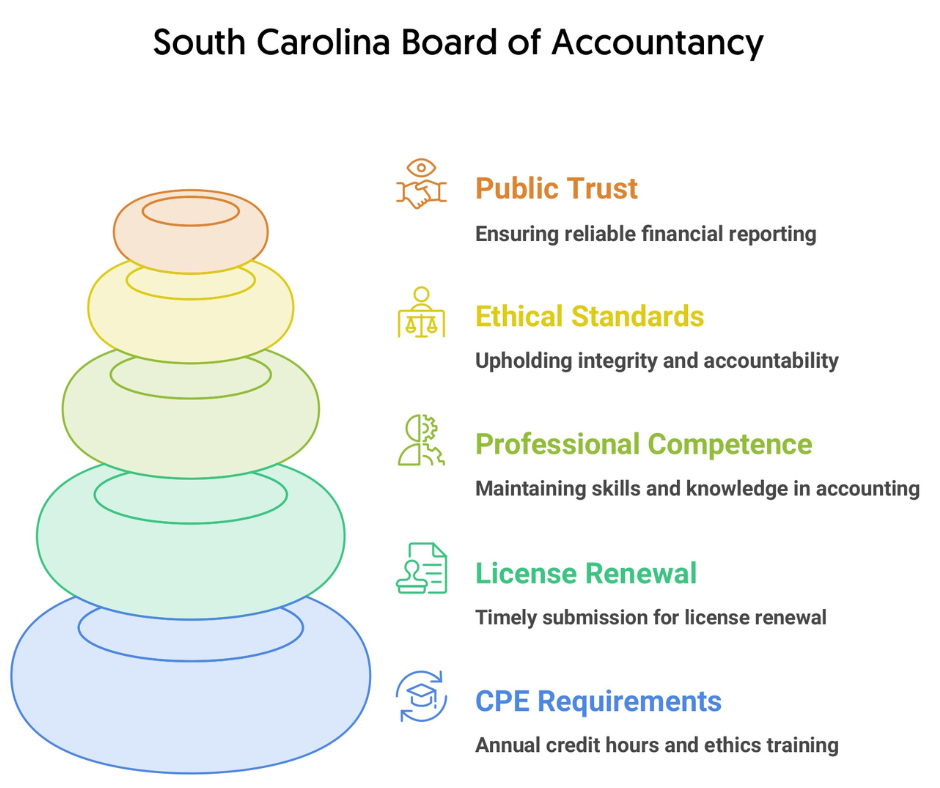
The key function of the South Carolina Board of Accountancy is to protect public interest by regulating the practice of accounting in the state. It fulfills this through several core duties. These are:
The BoA examines CPA applicants by verifying if they've met the necessary education and experience requirements and cleared the Uniform CPA Examination. It then issues licenses to CPAs. It also issues certificates to Public Accountants and Accounting Practitioners.
It verifies whether CPAs in the state fulfill all South Carolina Board of Public Accountancy CPE requirements before renewing their licenses. It also makes sure that public accounting firms renew their licenses on time.
It suggests rules and regulations along with codes of professional conduct for the state's accounting profession.
Apart from exceptions and exemptions, all active CPAs in South Carolina must complete a certain number of CPE hours every calendar year to renew their license. All CPAs must report and submit their CPE documentation through the NASBA CPE Audit Service, which is used by the Board to verify compliance. It verifies compliance with professional standards for accounting firms that perform reviews, audits, compilations, or attest services through the mandatory peer review process.
The South Carolina Board of Accountancy investigates complaints against practitioners and take disciplinary actions if need be. Violations of ethical guidelines or state statutes may lead to suspension or revocation of the CPA license. The South Carolina Board of Accountancy license lookup tool can be used by the public and employers to verify the license status, credentials, and disciplinary history of CPAs, Public Accountants, and registered firms.
Apart from being a regulatory body, the South Carolina Board of Public Accountancy plays a crucial role in upholding competence, integrity, accountability, and public trust in the profession. Its importance is prominent in multiple ways. These include:
By enforcing strict ethical and professional standards, the Board makes sure that the public can rely on accurate financial reporting. This trust helps stakeholders make the right financial decisions.
Almost all active CPAs in the state need to fulfill South Carolina Board of Public Accountancy CPE requirements, which help them stay current with the latest regulations and standards. As a whole, this ongoing learning elevates the profession's quality significantly.
By offering the South Carolina Board of Public Accountancy license lookup tool and maintaining accessible records, the BoA empowers the public to make informed decisions when hiring accounting professionals.
In the event of professional misconduct, the Board provides a straightforward way to submit complaints. Consumers can submit their complaints through an online portal, or email, or by sending them to the South Carolina Board of Public Accountancy's address. This safeguards consumers from unethical behavior, accounting fraud, or professional negligence.
Now that you have sufficient information about the South Carolina Board of Accountancy, it's time to understand its CPE requirements. To meet these requirements, you should:
Here are some other important guidelines you should remember:
It's created for:
This guide helps readers address the challenges of:
This information is applicable in several circumstances. For example:
It primarily applies across South Carolina, as the South Carolina Board of Accountancy is the regulatory body for CPAs, Public Accountants, and Accounting Practitioners in the state. However, it also applies to other states where non-resident South Carolina CPAs have their principal place of business. This is because they must comply with some CPE guidelines to renew their license here.
Readers should prioritize using the information shared in this guide because it:
Additionally, a strong understanding of the roles and responsibilities of the South Carolina Board of Public Accountancy helps consumers stay protected from professional negligence, accounting fraud, and unethical accounting practices.
If you're a CPA:
If you're a consumer:
The South Carolina Board of Accountancy is the cornerstone of professional accountability in the state. For practitioners, it's more than a regulatory body; it helps them maintain professional credibility and provides them with a clear pathway to career advancement. For the public, it is a safeguard, making sure that their accounting activities are handled by competent, ethical, and accountable practitioners.

Check out what other customers are saying.




 Login/Register