0

The Role of the Michigan State Board of Accountancy for CPAs |
| The Last Self-Study CPE Website You Will Ever Need (Click for Subscriptions) |
This page explains the Michigan State Board of Accountancy, including its structure and oversight functions, continuing education requirements and limitations, carryover and reciprocity rules, and the license renewal process, to help Michigan CPAs and candidates stay compliant.

The Michigan State Board of Accountancy regulates CPAs, CPA firms, and registered accountants in Michigan. Its oversight gives citizens, business owners, and investors a layer of protection against financial misconduct or misrepresentation.
Here, you'll find a straightforward guide to what the Michigan State Board of Accountants (Michigan State Board of Accountancy) actually does and what it expects when it comes to continuing professional education (CPE). The goal? To help you keep your credentials in good standing.
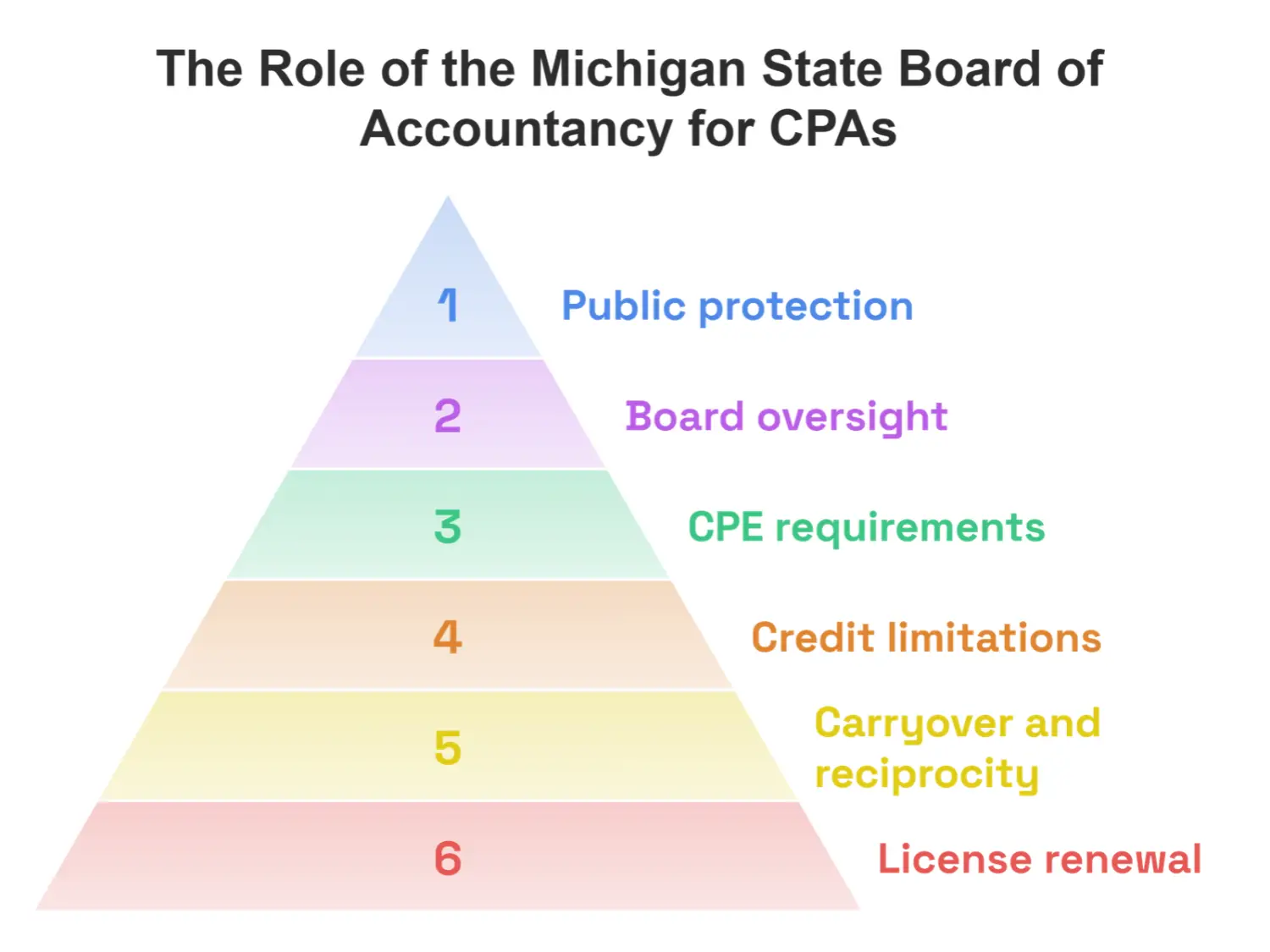
The Michigan State Board of Accountancy does a lot to keep the profession in check and protect the public. If you look at a CPA's career, from getting certified to meeting the Michigan State CPE requirements every year, the Board is involved at every step.
Here's what the BoA really does:
If you want to become a CPA in Michigan, you need to follow strict education and work experience rules. The Board checks every candidate's background before letting them in, so only people who qualify actually get licensed.
The Michigan State Board of Accountants also decides what counts as professional behavior. It spells out the rules for competence, ethics, and integrity. In short, what's expected if you want to practice as a CPA here.
CPAs have to meet the Michigan State CPE credit requirements, and the Board makes sure they do. This keeps accountants current as tax laws, industry standards, and regulations shift.
If you're a sole practitioner or a CPA firm doing audits, compilations, or reviews, you have to go through a peer review program every three years. There are three possible ratings: PASS, PASS with Deficiencies, and FAIL.
If there's a complaint about a CPA or a firm, say a possible ethics issue or outright negligence, the BoA looks into it. Anyone can file a complaint.
If a CPA breaks the rules, the Board steps in through LARA. Disciplinary actions include fines, probation, censure, restitution, suspension, or revocation of a license.
Here's what you need to know about the Michigan State CPE credit requirements for CPAs.
Non-resident licensees have a bit of leeway.
As a NASBA QAS Self-Study sponsor our courses are accepted by all U.S. states and territories and Canada. It's prudent to check a provider's status in the Registry before you sign up. You'll find CPEThink.com in there, too.
If you use the MICPA CPE Tracker, follow these steps to complete the renewal process:
Licenses must be renewed by July 31 every two years.
This page is intended for:
The information shared on this page helps solve the problems of:
As CPAs must engage with the BoA at several times throughout the year, this information is continuously relevant. For example:
The authority of the Michigan State Board of Accountants applies across the state. Its guidelines also cover non-resident CPAs looking to renew their Michigan licenses, ensuring that every practitioner adheres to the state's rules.
You should read and use the information shared here because:
The Michigan State Board of Accountancy sets and enforces the rules that Michigan CPAs and CPA firms follow. Understanding its CPE and renewal requirements helps you keep your license active.

Check out what other customers are saying.






 Login/Register