0

Massachusetts Board of Public Accountancy |
| The Last Self-Study CPE Website You Will Ever Need (Click for Subscriptions) |
Massachusetts CPAs can use this page to better understand the Massachusetts Board of Public Accountancy, its continuing education requirements, and available ethics training options. The page explains license renewal deadlines, ethics requirements, first-time renewal obligations, approved continuing education practices, and Board guidance, helping accounting professionals remain compliant, maintain professional competence, and confidently manage their continuing education responsibilities.
1. Who is this list of CPE courses for?This list of CPE courses and guide is designed for practicing Massachusetts CPAs, CPA candidates, newly licensed CPAs, out-of-state CPAs and public accounting firms seeking to practice in Massachusetts, and consumers who want to understand the role and requirements of the Massachusetts Board of Public Accountancy. 2. What is this list of CPE courses about or what problem does this course solve?This list focuses on Massachusetts ethics and Board-related CPE education while helping CPAs understand licensing requirements, renewal obligations, ethics education requirements, reporting periods, first-time renewal rules, and acceptable continuing education activities needed to remain in good standing with the Massachusetts Board of Public Accountancy. | 3. Why is this list of CPE courses important to a CPA or Accountant?This list is important because it helps CPAs maintain compliance with Massachusetts continuing education requirements, strengthen professional competence, uphold ethical standards, avoid disciplinary issues, and enhance credibility with clients and the public. 4. When is this list of CPE courses relevant or timely?This list is relevant throughout a CPA's professional career, especially during each biennial CPE reporting and license renewal cycle, when completing required ethics and continuing education hours is necessary to maintain an active Massachusetts CPA license. | 5. Where can this list of CPE courses be found and accessed?This list can be accessed online through CPEthink.com, where Massachusetts CPAs can review available ethics courses, learn about Board requirements, and complete self-study continuing education programs. 6. How is a list of CPE courses like this consumed or used?CPAs use this list to identify qualifying ethics and continuing education courses, select programs that satisfy Massachusetts requirements, complete self-paced learning, document earned credits, and support successful license renewal and ongoing professional development. |
The Massachusetts State Board of Accountancy regulates CPAs and public accountancy firms in the Commonwealth. Its mission is to protect consumers, ensure professional competence, and uphold the integrity of the accounting profession.
This guide will focus on all the important aspects of the Massachusetts Board of Accountancy, helping you gain a clear understanding of its core responsibilities and CPE requirements. If you're a CPA already practicing or looking to practice here, it'll help you remain in good standing with the Board while elevating professional competence.
The Board's primary mission is to safeguard public interest by making sure that CPAs meet strict standards of competence, integrity, and ethics. Its core responsibilities include:
The Massachusetts State Board of Public Accountancy evaluates CPA candidates' education (total 150 hours), their results of the Uniform CPA Exam, their professional experience (minimum one year in public accounting under a licensed CPA or three years if in a non-public role), and their character before granting CPA credentials.
It oversees license renewals of CPAs by making sure they've met all the Massachusetts Board of Public Accountancy CPE requirements. It essentially helps practitioners stay current with evolving standards.
This is another critical responsibility of the Board. It makes sure that only licensed CPAs can issue financial reports for organizations and businesses, protecting the consumers from misleading or inaccurate financial information.
Additionally, it has a Massachusetts Board of Public Accountancy license lookup (also known as Massachusetts State Board of Accountancy license lookup) page that consumers can use to verify a CPA's license they're thinking about working with. CPAs can also use it to check the status of their own licenses.
The Massachusetts Board of Accountancy regulates CPAs through disciplinary oversight. It thoroughly investigates complaints against them and takes disciplinary actions when necessary. Those actions are published on its website to maintain transparency and public trust.
Lastly, the Board creates, interprets, and enforces policies, guidelines, and rules that govern the public accounting profession within the state.
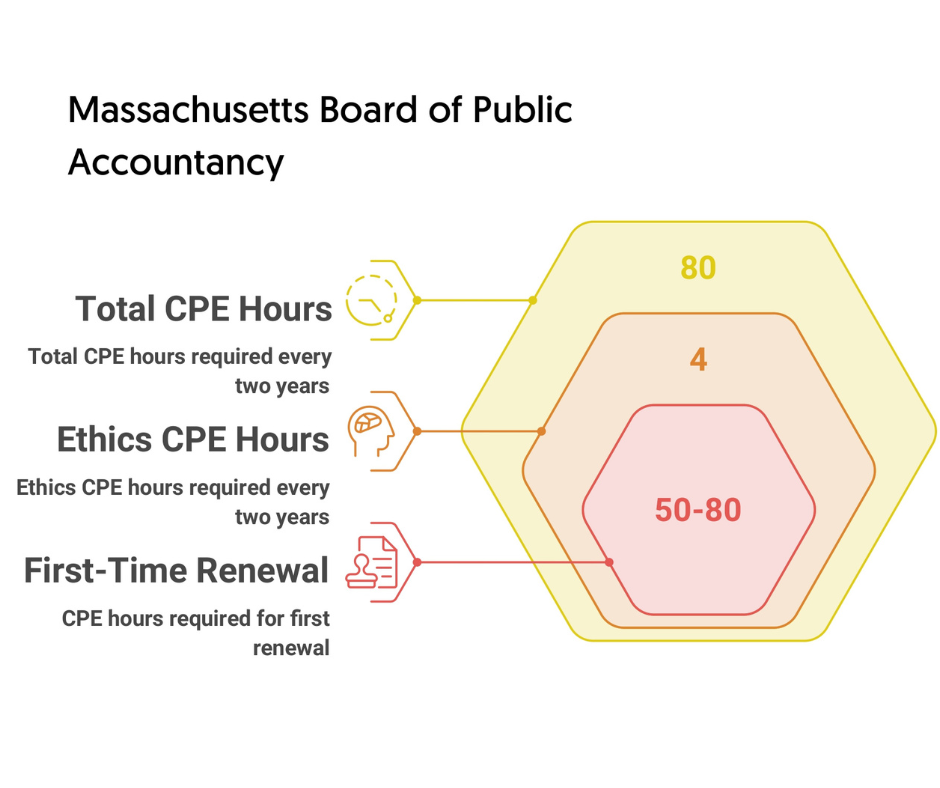
Now that you have a clear idea of the primary responsibilities of the Board, let's dive into its CPE requirements. Since it's an integral part of the Massachusetts Board of Public Accountancy License renewal process, CPAs must meet all the requirements within the deadlines. Here's what you need to know.
The month you received your license determines the number of CPE hours you must complete for the first renewal cycle. Here are the details:
Individuals whose principal place of business is outside Massachusetts may practice public accountancy in the state without holding a Massachusetts license, provided they hold a valid CPA license from a state verified by the National Qualification Appraisal Service of NASBA as substantially equivalent to the Uniform Accountancy Act (M.G.L. c. 112, section 87B(h)(2)). Firms from another state must still obtain a Massachusetts license, through a simplified reciprocity showing rather than a full application (M.G.L. c. 112, section 87B 1/2(k)).
Note: NASBA's model law has since moved away from a state level standard called substantial equivalency toward a standard based on individual qualifications, and Massachusetts has a pending bill (S.2946) that would adopt this change. Because these requirements are changing, confirm your specific eligibility with the Massachusetts Board of Public Accountancy before relying on this practice privilege.
To have your CPE hours approved for formal correspondence or other individual study programs, you must demonstrate that:
If the Board doesn't receive the log and guideline, it'll grant up to 20 CPE hours for any single program. If a program is offered by a state or national accounting organization that has already designated the number of CPE hours to be granted upon its completion, the Board won't award more than it.
When it comes to obtaining CPE hours through presenting formal programs of learning, these guidelines apply:
Under any circumstances, you won't receive more than 40 CPE hours in one renewal period for presentation or preparation to present programs.
It helps:
The information available in this guide helps address the challenges of:
This information remains relevant throughout your CPA career. This is because, as a licensed CPA, you must meet all the CPE requirements every two years to maintain an active designation. This guide helps you complete the right courses and choose credible CPE providers.
For aspiring CPAs, it provides details of the Board's responsibilities and what they'll need to comply with after obtaining the license.
It also helps consumers verify CPA credentials when they want to be assured that their financial reports are handled by eligible CPAs.
It applies to:
A strong understanding of the Board's CPE requirements helps you select the right programs as per professional requirements, which, in turn, accelerates your career growth.
This guide helps you comply with the Board's rules, keeping you away from disciplinary actions that may damage your professional reputation.
When prospective clients see that you're committed to maintaining the highest standards of service through continuing education, it boosts professional credibility and builds trust.
The Massachusetts State Board of Accountancy plays a pivotal role in shaping the CPA profession in the state. It helps CPAs maintain professional competence and remain accountable by establishing strict CPE requirements and enforcing disciplinary actions if need be. Ultimately, the Board's work makes sure the public can rely on ethical professional conduct and accurate financial reporting.

Check out what other customers are saying.





 Login/Register