0

A Guide to the Maryland Board of Public Accountancy |
| The Last Self-Study CPE Website You Will Ever Need (Click for Subscriptions) |
This page explains the Maryland Board of Public Accountancy, including its history and primary duties, continuing education requirements and approved CPE methods, credit limitations, and the license renewal and reinstatement process, to help Maryland CPAs and candidates stay compliant.

The Maryland Board of Public Accountancy regulates the public accountancy profession in the state. Its mission is to establish educational and professional standards of competence and conduct for CPAs who provide financial services to Maryland businesses and citizens. These standards apply whether a CPA is answering complex financial questions, preparing tax returns for families, or auditing companies.
This guide will walk you through what the Board does, where it came from, and what you need to know about continuing education requirements so you can plan your continuing education and keep your license current.
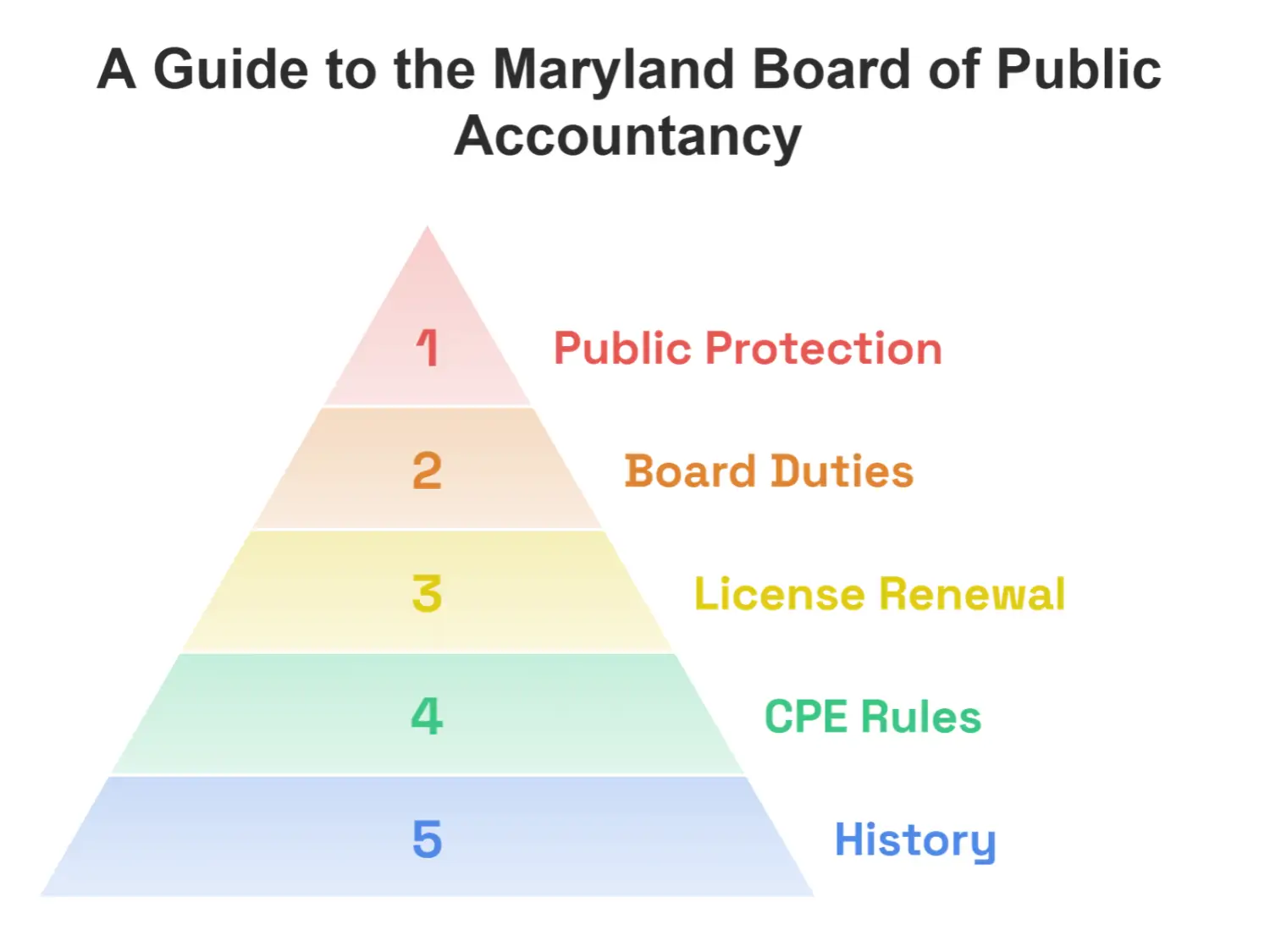
The Maryland State Board of Accountancy's (Maryland Board of Public Accountancy) main goal is to make sure that CPAs and CPA firms within the state provide competent and ethical financial services to Maryland businesses and citizens. It does this through examination, licensure, continuing education, investigation of complaints, and enforcement of state law and regulations.
Here's what the Maryland Board of Accountants (Maryland Board of Public Accountancy) handles:
The Maryland Board of Public Accountancy grants licenses to individuals and permits to CPA firms that meet its requirements. It makes sure CPA candidates meet every requirement, from eligibility and passing the Uniform CPA Exam to completing the AICPA's Professional Ethics course. CPA firms from other states generally need a Maryland firm permit to serve Maryland clients, with exceptions for certain attest services and for out-of-state sole practitioners.
If you want to keep your CPA license active in Maryland, you have to keep up with the Maryland State CPE requirements each reporting period. This keeps CPAs current on changes in laws and the profession. In addition, CPA firms and individual CPAs who perform audit or compilation services must undergo a peer review every three years.
The Maryland State Board of Accountants (Maryland Board of Public Accountancy) has a formal process for citizens and stakeholders to file complaints against CPAs. Complaints may involve ethical violations, negligence, or fraud. The Board's Complaint Committee reviews each complaint. If it determines a violation may have occurred, the Maryland Office of the Attorney General reviews the facts to decide whether to proceed with a formal hearing.
The Board enforces disciplinary actions once violations are confirmed. The Board may reprimand, suspend, or revoke a license, and may also impose a fine of up to $5,000 per violation. Anybody can check if a Maryland CPA has faced disciplinary actions in the past. For CPAs licensed in other jurisdictions, the CPAverify tool can be used to verify their status.
The Maryland State Board of Accountancy updates, proposes, and adopts regulations governing the state's public accountancy practice, including changes that reflect national standards and new legislation.
Now that you know what the BoA actually does, let's see what the Maryland State CPE credit requirements entail.
Apart from Maryland State CPE ethics, the Board doesn't have other subject area requirements. You're free to choose from these technical and non-technical subject matters to fulfill CPE requirements:
While you can meet Maryland State CPE credit requirements through various formats, some options come with credit limitations. These include:
The information in this guide helps:
It provides key information about the Maryland Board of Public Accountancy, helping you address the challenges of:
Plus, for the public, it explains how to file a complaint against a CPA in case of rule violations.
The work of the Maryland Board of Accountants is relevant at every stage of your professional journey as a CPA, and so is this guide. Specific instances include:
Whether you're an individual CPA or one working at a CPA firm in Maryland, this information is useful to you. Additionally, if you're an out-of-state active CPA, you need to meet the Board's requirements to practice here through mobility.
The Maryland Board of Public Accountancy regulates the profession and protects the public in the state. Its oversight and standards help keep practitioners competent and accountable.
If you need more information regarding meeting Maryland State CPE requirements, feel free to reach out to CPEThink.com.

Check out what other customers are saying.




 Login/Register