Home
0
Home

Pennsylvania State Board of Accountancy CPE Courses for CPAs

The Last Self-Study CPE Website You Will Ever Need
(Click for Subscriptions)


TL;DR Summary

This page helps Pennsylvania CPAs quickly understand and meet their State Board of Accountancy CPE requirements by offering self-study courses aligned with the state’s 80-hour biennial cycle, ethics mandates, and subject-specific rules. It serves as a practical resource for staying compliant, planning CPE efficiently, and maintaining an active CPA license without unnecessary complexity.
 

Pennsylvania_State_Board_of_Accountancy_CPE_Courses_for_CPAs1

The Who, What, When, Where, Why, & How

1. Who is this list of CPE courses for?

This list of CPE courses is intended for CPAs, public accountants, and accounting professionals who are licensed in Pennsylvania or seeking to meet the Pennsylvania State Board of Accountancy requirements for license renewal.

2. What is this list of CPE courses about or what problem does this course solve?

This list focuses on helping professionals meet the Pennsylvania State Board of Accountancy CPE requirements, addressing the challenge of staying compliant with mandated education, ethics, and subject-specific credit rules necessary to maintain an active CPA license.

3. Why is this list of CPE courses important to a CPA or Accountant?

These courses are important because they directly support compliance with Pennsylvania’s required 80 CPE hours per biennial cycle, including ethics and subject-matter requirements, which are essential for maintaining licensure and professional standing.

4. When is this list of CPE courses relevant or timely?

This list is most relevant during each two-year CPE reporting cycle—particularly as professionals approach annual minimums, ethics requirements, or license renewal deadlines set by the Pennsylvania State Board of Accountancy.

5. Where can this list of CPE courses be found and accessed?

These courses can be accessed through an online self-study CPE platform, where Pennsylvania CPAs can search, select, and complete qualifying courses that meet Board-approved or recognized provider standards.

6. How is a list of CPE courses like this consumed or used?

The courses are used as self-study programs that professionals complete at their own pace, selecting appropriate subjects and credit amounts to fulfill Pennsylvania-specific CPE requirements and maintain compliance.


Item Types:
Field of Study:
Authors:
CPE Hours:
Keyword:


Your Ultimate Guide to the Pennsylvania State Board of Accountancy

Accounting isn’t just about crunching numbers; it’s also about being honest, transparent, and trustworthy. In Pennsylvania, the Pennsylvania State Board of Accountancy stands guard over these values. It’s the official body that makes sure CPAs, accounting firms, and public accountants across the state play by the rules.

If you’re a CPA in Pennsylvania, whether you’re just starting out or you’ve been in the profession for years, you need to know the Pennsylvania CPE requirements. It’s the key to keeping your Pennsylvania CPA license renewal simple and worry-free. This guide shares all the things you need to know.
Pennsylvania_State_Board_of_Accountancy_CPE_Courses_for_CPAs2

Before we start discussing the requirements, here are some important facts.

What Is the Pennsylvania Board of Accountancy?

  • It’s part of the Department of State’s Bureau of Professional and Occupational Affairs (BPOA).
  • It’s the regulatory authority for the accounting profession in the state.
  • Its mission is to safeguard public interest by ensuring that accountants and accounting firms meet strict educational, professional, and ethical standards.

Key Responsibilities of the PA Board of Accountancy

  • Keeps Pennsylvania’s accounting standards in line with what NASBA and AICPA set nationally.
  • Issues CPA licenses and handles renewals.
  • Makes sure that CPAs fulfill the Pennsylvania State Board of Accountancy CPE requirements to keep their licenses active.
  • Regulates accounting firms in Pennsylvania, checking that each one follow the rules and state laws.
  • Looks into complaints about misconduct and enforces disciplinary actions when someone acts unprofessionally or unethically.

Principal Pennsylvania CPE Requirements

  • The Pennsylvania State Board of Accountancy has a two-year cycle for license renewal and CPE reporting. The cycle starts 1st January of even-numbered years and ends 31st December of the next odd-numbered years. For instance, January 1, 2026, to December 31, 2027, is one cycle.
  • Every two years, you must complete at least 80 CPE hours in programs approved by the Board.
  • You’ve to do a minimum of 20 CPE hours in each calendar year.
  • You need to complete 4 hours in ethics subjects as part of your total Pennsylvania CPE requirements CPA.
  • If you work on attest activities, you need to complete 24 hours in Accounting & Auditing subjects (included in your total requirements).
  • If you just passed the CPA Exam, you get a break because no CPE is required for that biennium.

Pennsylvania State Board of Accountancy CPE Requirements: Other Important Policies

  • You can earn up to 40 credits through self-study programs. That’s also the maximum if you combine self-study and authorship of published materials.
  • You may not claim more than 40 credits for:
    • Instruction, and the courses have to be above entry level. You can only repeat a course if the content has changed a lot.
    • Published materials (up to 20 credits each time)
  • College or university courses can count toward your CPE, but only if you’re not using those credits to meet the Degree Requirement.
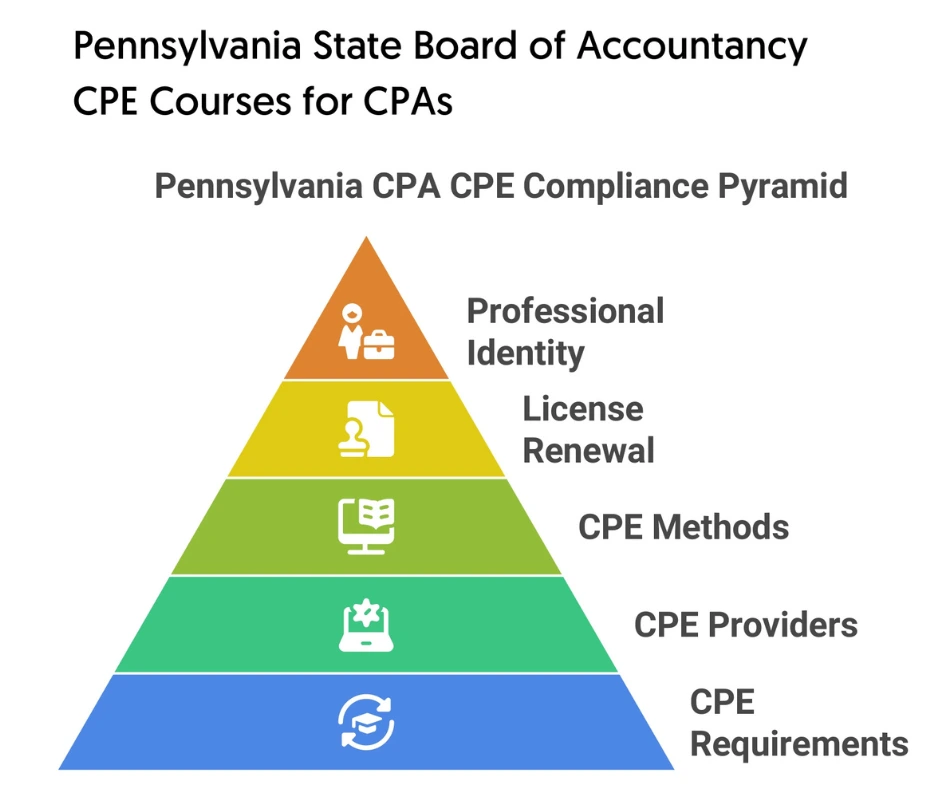
  • To meet Pennsylvania Accountancy Board CPE requirements, make sure your courses come from one of these CPE providers:
    • Approved by the Pennsylvania State Board of Accountants
    • Listed on NASBA’s National Registry of CPE Sponsors
    • Approved by another state’s Board of Accountancy
  • When it’s time to report your CPE to the Board, use the Pennsylvania CPE reporting form.

If you want more details about PA State Board of Accountancy renewal, check out this page.

Pennsylvania CPA License Renewal Rules for Licensees Practicing Under Automatic Mobility or Reciprocity

  • Comply with the CPE rules of the state where your license is active and renewed.
  • If that state doesn’t have CPE requirements, then you’ve to meet all Pennsylvania CPE requirements.
  • If Pennsylvania is the state of your principal place of business, you need to complete the entire renewal process set by the Pennsylvania Board of Certified Public Accountants.

Who Does This Guide Help?

This guide is for you if:

  • You’re a licensed CPA, a public accountant, or part of a CPE firm working in Pennsylvania.
  • You’re a CPA from another state and you want to renew your license here.

In short, if you’re an accounting professional who wants to get a handle on the CPE requirements of the Pennsylvania Board of Accountants, this guide gives answers to your questions.

What Problems Does This Guide Tackle?

Staying on top of the CPE requirements of the Pennsylvania State Board of Public Accountancy can be challenging. This guide helps you:

  • Meet the Board’s educational, professional, and ethical standards.
  • Stay compliant with Pennsylvania Accountancy Board CPE requirements.
  • Pick the right CPE providers and courses (and know which credits count).
  • Understand how many CPE credits you can earn through different methods of learning.
  • Keep your reputation strong in a field where credibility really matters.

When Can You Use This Guide?

You’ll find this guide handy at any point in your accounting career. You can use it when you’re:

  • Preparing for the Uniform CPA Exam and want to know what the PA Board of Accountancy expects after granting you the license.
  • Renewing your license and need to double-check CPE details.
  • Mentoring junior accounting professionals or making sure your shole firm stays in line with the rules.

Where Does This Guide Matter?

The Board’s rules run throughout the Commonwealth of Pennsylvania, so if you’re an active CPA here, this guide applies to you.

For CPAs licensed in other states, keep in mind that the Pennsylvania Board of Accountancy doesn’t just accept your credentials by default. Instead, you’ll need to complete the Board’s Pennsylvania CPA license renewal process to practice here, and this guide explains how that works.

Why Make Reading It a Priority?

Here’s the bottom line: having a deep understanding of the Pennsylvania State Board of Accountancy CPE requirements isn’t optional; it’s essential. You need to know these rules because:

  • Maintaining an active license is the foundation of your professional identity as a CPA.
  • Staying compliant with educational and ethical standards keeps you out of trouble and protects your reputation.
  • Meeting CPE requirements effectively keeps you away from headaches like suspension or losing your licensure.

How Do You Put This Guide to Work?

  • Review all Pennsylvania CPE requirements carefully.
  • Keep up with CPE reporting and renewal deadlines, and earn all required CPE credits on time to keep your license active.
  • If you’re looking at CPE providers listed on NASBA’s National Registry, double-check their information before signing up (you can find our details here).

The Takeaway

At the end of the day, the Pennsylvania State Board of Accountancy sets the foundation for your career as a CPA. Every rule, every renewal, and every compliance detail – it all adds up to your legitimacy in the eyes of the public. When you know the Pennsylvania CPE requirements cold, you don’t just protect your license, but you also build a career that can handle whatever changes come next.

 

seperator


Check out what other customers are saying.


Click to go to: Cpethink.com Home
Thank you for taking one of our free courses. We would like to be able to let you know when we add free courses or have special offers and will never spam you or share your address with anyone. If you are Ok with that please reply with "Ok" or if not please reply "No Thanks". Either way enjoy your free CPE course.
  
Exam completed on .

Do you want to add the course again?