Home
0
Home

Georgia State Board of Accountancy | CPE for CPAs

The Last Self-Study CPE Website You Will Ever Need
(Click for Subscriptions)


TL;DR Summary

This page helps Georgia CPAs quickly find self-study CPE courses that align with Georgia’s biennial renewal rules, covering required ethics (Georgia specific ethics CPE) and technical learning, so you can earn the right credits, at the right time, with confidence.
 

Georgia State Board of Accountancy: The Who, What, When, Where, Why, & How

1. Who is this list of CPE courses for?

This list is for Certified Public Accountants licensed in Georgia, non-resident CPAs seeking Georgia reciprocity, and public accounting professionals who need Georgia compliant continuing education, including a Georgia specific ethics requirement.

2. What is this list of CPE courses about or what problem does this course solve?

The list presents Georgia-relevant self-study CPE options, including a Georgia-specific professional ethics course and a technical accounting course, that help CPAs meet biennial credit, ethics, and technical field-of-study requirements without confusion.

3. Why is this list of CPE courses important to a CPA or Accountant?

These courses directly support Georgia license renewal by addressing required ethics content (including Georgia specific ethics) and technical learning, helping professionals avoid noncompliance, penalties, or wasted credits.

4. When is this list of CPE courses relevant or timely?

The courses are most relevant during Georgia’s biennial CPE reporting and license renewal cycle, which ends on December 31 of odd-numbered years, and for new licensees calculating first-period requirements.

5. Where can this list of CPE courses be found and accessed?

The courses are accessed on the CPEThink website’s Georgia State Board of Accountancy CPE page, where users can search, review details, and add courses to their cart for self-study completion.

6. How is a list of CPE courses like this consumed or used?

CPAs select self-study text or video courses, complete the material and final exam, and apply earned credits toward Georgia’s biennial renewal, tracking ethics and technical totals to remain compliant.


Item Types:
Field of Study:
Authors:
CPE Hours:
Keyword:
Records per page:
All Items
Records per page:


Guardian Of the Profession: Georgia State Board of Accountancy (GSBA)

The Georgia State Board of Accountancy (GSBA) is the cornerstone of the accounting profession, ensuring professional growth and public trust. By enforcing professional accountability and ethical standards, it helps CPAs remain trusted financial advisors to individuals, businesses, and investors.

Similar to other jurisdictions, Georgia has strict CPE requirements. Navigating these might feel difficult unless you’ve a clear understanding of Georgia CPA requirements. This page will help you get that and make pursuing CPE a rewarding learning experience.
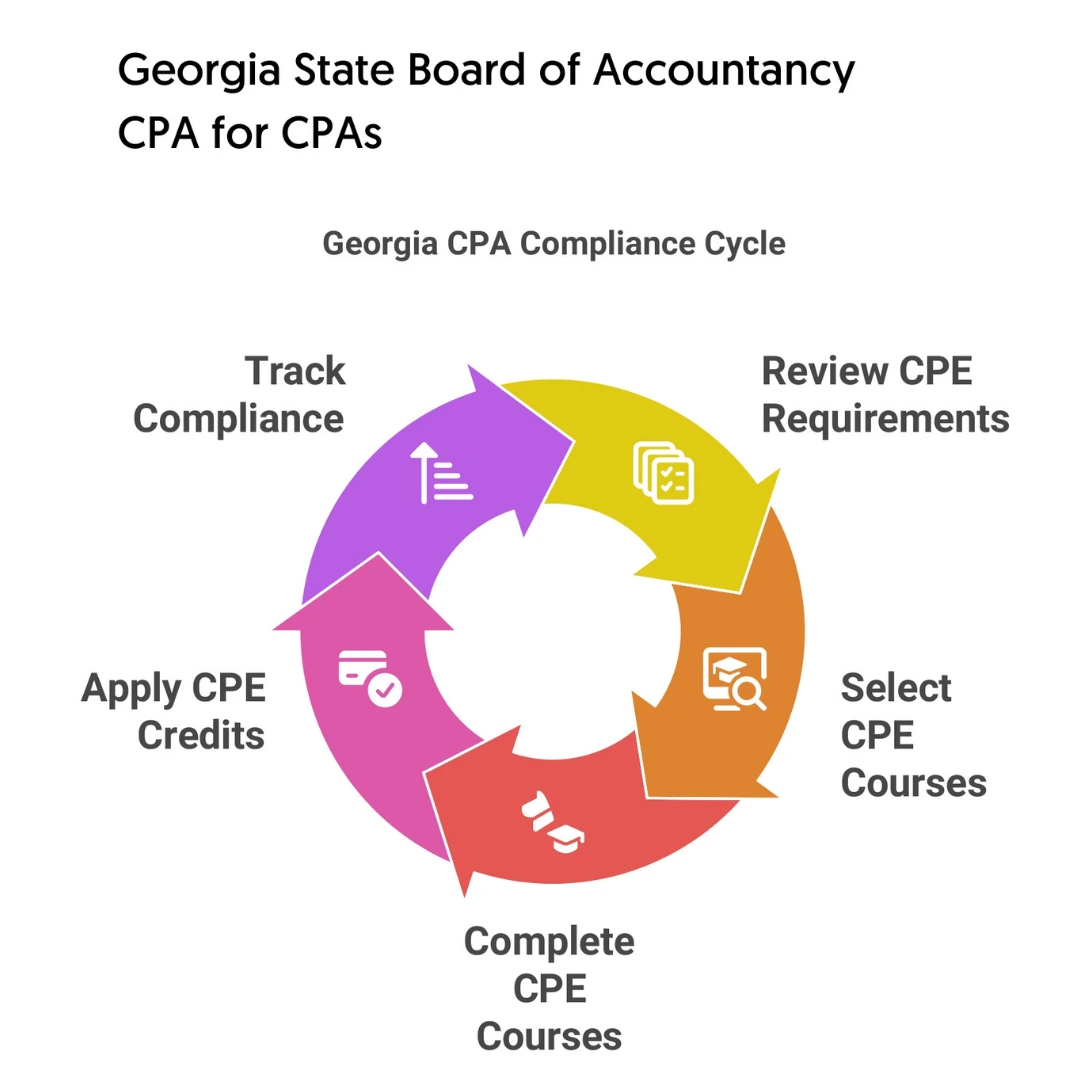
Let’s take a quick look at how the Georgia Board of Accountancy safeguards the integrity of the accounting profession.

Core Responsibilities of the Georgia State Board of Accountancy (GSBA)

  • Overseeing licensing applications, reinstatements, and renewals for individual CPAs and public accounting firms in Georgia.
  • Managing CPE reciprocity.
  • Enforcing Georgia CPE requirements and ensuring that CPAs comply with them.
  • Approving Georgia-specific ethics programs.
  • Implementing peer review requirements for all CPA firms that perform audits, compilations, or reviews. A Board-approved peer review must be completed within 36 months prior to the registration expiration of the firm.

Georgia CPA Requirements: A Detailed View

Meet these criteria to ensure a smooth Georgia CPA license renewal process.

  • Georgia has a biennial CPE reporting period, meaning you need to fulfill Georgia CPA education requirements within this time frame.
  • The Georgia State Board of Accountancy license renewal period is also biennial, and it ends on December 31.
  • Both CPE reporting and license renewal periods end in odd years.
  • You must earn a total of 80 credits every two-year period, with a minimum of 20 credits each year.
  • These credits must include four credits in ethics. Among these, one credit has to be in Georgia CPE ethics. This program must be approved by the Georgia State Board of Accountancy (GSBA). You can obtain other credits in regulatory or behavioral ethics to meet the overall Georgia CPA ethics requirements.
  • At least 50% of Georgia CPA CPE credits need to be in technical fields of study.
  • If you receive your license in the second year of a reporting period, you don’t need to meet any Georgia CPA requirements.
  • If you get your license in the first year, you need to earn 40 CPE credits. You need to earn at least 50% of these credits in technical fields of study. Your total credits must include four in ethics with one in a GA-specific program.
  • Up to 15 credits can be carried forward from one reporting period to the next one. However, you cannot use these credits to meet the technical requirements of that period.
  • Also, you cannot use these credits to fulfill the yearly minimum Georgia CPE credit requirements or Georgia CPA ethics requirements.
  • The Georgia State Board of Accountancy doesn’t pre-approve any CPE sponsors or programs (other than the GA-specific ethics course). Therefore, you and your CPE provider need to determine whether or not a certain program meets Georgia CPA license requirements. The Board accepts credits received from National Registry sponsors.
  • The GA State Board of Accountancy allows you to obtain all your required credits through self-study. In that case, you must earn at least one-half credit first before you can obtain credits in one-fifth or one-half increments.
  • Any licensee of 70 years of age or older doesn’t need to complete the Georgia CPA license renewal process to practice public accountancy.
  • If you’re a non-resident licensee looking to renew your license in Georgia, you need to demonstrate that you’ve complied with the CPE requirements of the state where your principal place of business is located.
  • If that state doesn’t have any CPE requirements, you must fulfill all Georgia CPE requirements.

It’s important to note that for licensure in Georgia, you must meet the Georgia CPA experience requirements. These include at least one year of work experience or the completion of a minimum of 2,000 hours within a 12-month period. However, you cannot use these hours to fulfill Georgia CPA requirements, as both are completely different.

Who Does the Information About the Georgia Board of Accountancy Help?

This information helps:

  • Certified Public Accountants (CPAs) based in Georgia.
  • CPAs, whose principal place of business is outside Georgia, looking for CPA reciprocity.
  • Public accounting firms operating in Georgia.
  • Employers and businesses looking for assurance that their CPAs comply with professional standards and keep abreast of the latest accounting rules and regulations.
  • The general public who depends on correct financial reporting.

What Problems Can Be Solved Using the Information About the Georgia State Board of Accountancy?

With a strong understanding of the guidelines set forth by the Georgia State Board of Accountancy (GSBA), you can address the challenges of:

  • Meeting Georgia CPA requirements in a timely manner. This helps you avoid fines, revocation or suspension of your license, and damage to your credibility.
  • Maintaining a stress-free Georgia CPA license renewal process.
  • Finding a reliable sponsor to meet Georgia CPA education requirements.
  • Enrolling in the right Georgia CPE ethics program.

When Does This Information Become Relevant?

Information regarding the GA State Board of Accountancy becomes relevant during:

  • License renewal and CPE reporting periods, both of which end on December 31, biennially.
  • The calculation for Georgia CPE credit requirements for new licensees.
  • Compliance checks and annual reporting for public accounting firms.

Where Can You Apply the Information Regarding the GA State Board of Accountancy?

The authority of the Georgia State Board of Accountancy (GSBA) applies to the entire state of Georgia. Therefore, all CPAs and public accounting firms operating in the state can apply this information to elevate professional competence, stay compliant with its rules and regulations, and uphold public trust.

As the Board has reciprocity agreements with other states, CPAs based in those states can also use this information to meet Georgia CPE requirements.

Why Should You Prioritize the Information About Georgia CPE Requirements?

This is crucial because:

  • You need to have clear guidelines to maintain your license and improve professional competence.
  • You must join the right CPE sponsors to ensure that your credits are accepted by the Georgia State Board of Accountancy.
  • You need to get the right number of credits in technical and non-technical fields of study and ethics to ensure compliance and that you don’t waste effort, time, and money on earning excess credits that the board may not recognize.

How Do You Solve the Problems Using This Information?

You should take these steps to solve the above problems efficiently.

  • Join one of the National Registry Sponsors. Remember to verify its credibility by searching the Registry. For example, you can see our details here.
  • Join a Board-approved ethics provider. You can use this page to find one.
  • If you run a firm, undergo peer reviews, maintain your registration, and strictly adhere to GSBA regulations to maintain credibility.

Key Takeaway

The Georgia State Board of Accountancy (GSBA) is more than a governing body. It protects integrity, promotes ethics, and helps maintain public trust by keeping CPAs and accounting firms skilled, reliable, and ethical.

 

seperator


Check out what other customers are saying.


Click to go to: Cpethink.com Home
Thank you for taking one of our free courses. We would like to be able to let you know when we add free courses or have special offers and will never spam you or share your address with anyone. If you are Ok with that please reply with "Ok" or if not please reply "No Thanks". Either way enjoy your free CPE course.
  
Exam completed on .

Do you want to add the course again?