Home
0
Home

A CPE Compliance Checklist For CPAs

The Last Self-Study CPE Website You Will Ever Need
(Click for Subscriptions)


TL;DR Summary

This page offers CPAs a practical CPE Compliance Checklist course designed to simplify how continuing education requirements are tracked and documented. It helps accounting professionals stay organized, avoid last-minute compliance issues, and maintain active licensure by clearly outlining what needs to be completed, when it’s due, and how to properly document it.


The Who, What, When, Where, Why, & How

1. Who is this list of CPE courses for?

This list of CPE courses is for CPAs and other accounting professionals who need a clear, structured way to understand and manage their ongoing CPE compliance obligations.

2. What is this list of CPE courses about or what problem does this course solve?

The list focuses on a CPE Compliance Checklist course that helps CPAs organize, track, and document required CPE credits while reducing confusion around state board requirements.

3. Why is this list of CPE courses important to a CPA or Accountant?

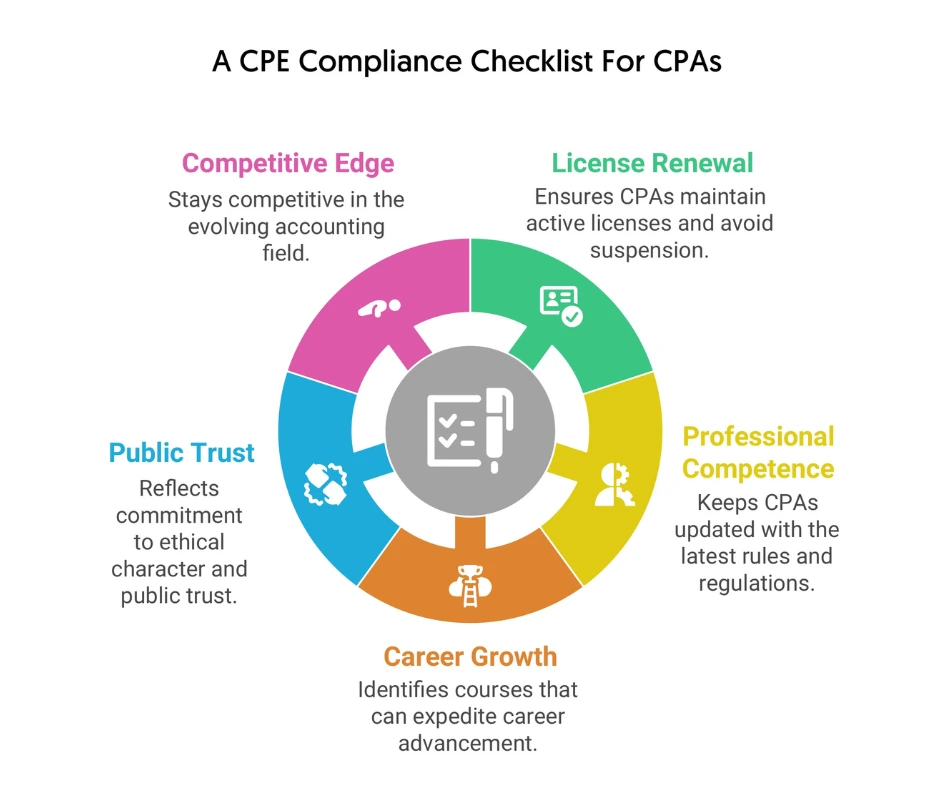
It supports license renewal by helping CPAs avoid penalties or suspension and clearly understand ethics, subject-area, and reporting requirements imposed by state boards.

4. When is this list of CPE courses relevant or timely?

The course is relevant year-round, particularly during CPE reporting periods, before license expiration dates, and when new regulations affect CPE requirements.

5. Where can this list of CPE courses be found and accessed?

This list is available on the cpethink.com website within its self-study CPE course catalog, where the CPE Compliance Checklist course can be accessed online.

6. How is a list of CPE courses like this consumed or used?

CPAs use this course as a planning and reference tool to track credits, document certificates, confirm compliance, and prepare for possible CPE audits.


Item Types:
Field of Study:
Authors:
CPE Hours:
Keyword:
Records per page:
All Items
Records per page:


Understanding The Importance of A CPE Compliance Checklist

No matter which jurisdiction you’re licensed in as a CPA, completing the required CPE hours is essential to maintain your professional competence and stay updated with the latest rules and regulations in the field. However, for many CPAs, this often becomes a challenging task. But with the help of a CPE compliance checklist, you can make this easily achievable.
On this page, we’ll explore how it can help you avoid the last-minute rush for obtaining the necessary CPE credits.

What Is A CPE Compliance Checklist?

This is a structured guide that helps CPAs ensure that they fulfill all the CPE requirements required by their state boards of accountancy and other professional organizations, such as the AICPA. Essentially, by maintaining CPA compliance, you can easily avoid fines, penalties, or license suspension.

Fundamental Components of CPE Compliance

Completing your CPA requirements on time involves several crucial factors. So, when you choose to use an online CPE compliance checklist, you need to ensure that it’ll let you do these efficiently.

  • Determine if your state has annual, biennial, or triennial requirements.
  • Determine the minimum number of credits annually, if your state has one.
  • Understand the right ethics requirements. This is important because some states require their CPAs complete state-specific ethics CPE, while others have general ethics requirements.
  • Depending on your actual professional responsibilities, you might need to obtain a certain number of tax or A&A (Accounting & Auditing) credits. So, when maintaining online CPE compliance, the checklist must help you get a clear understanding of them.

Making The Most Out of CPA Compliance

This shouldn’t be a difficult task if you do these when using a CPE compliance checklist for CPAs.

  • Maintain clear logs of all completed courses. Key pointers are the course name, CPE sponsor, start & end dates, credits, and the field of study.
  • Properly document the mode of completing CPE hours with official certificates. Whatever the mode is, it must be documented clearly.
  • Retain all certificates of completion, ideally for at least five years. This is essential if the Board wants to audit your CPE compliance.

Common Mistakes to Avoid When Using an Online CPE Compliance Checklist

You need to avoid these crucial mistakes when using it.

  • When a CPE compliance checklist from a reputable CPE provider is typically accurate, poor planning and last-minute rush may lead to significant errors in reporting. So, have a strong plan right from the beginning of your reporting period.
  • Audit your own records periodically without relying solely on the checklist. You need to make sure that all your certificates have been correctly uploaded to it. Ideally, you should do a mid-year review to avoid last minute surprises.
  • Some state boards let their CPAs carry over additional credits from one reporting cycle to the subsequent one, but others don’t. Ensure that you can carry over credits by cross-checking it with your state board.
  • Always store physical copies of all your certificates in a secure, personal place. Even if the platform fails somehow, you won’t lose proof of completion. You may also use a Google Sheet or Excel spreadsheet as a backup to the online checklist.

Who Does Online CPE Compliance Help?

It helps:

  • CPAs who must keep their licenses in active status.
  • Other accounting professionals, such as IRS Enrolled Agents, who must earn 72 credits every three years.
  • CPA firms and other employers who want their staff to maintain CPE compliance.
  • Aspiring CPAs who want to clearly understand how to stay compliant after getting licenses.

In short, anybody who holds a CPA or IRS EA license or plans to get one benefits from understanding this compliance.

What Problems Does CPA Compliance CPE Solve?

With an accurate checklist, you can:

  • Avoid penalties, suspension, or loss of your license. With this, you stay legally authorized to offer professional services.
  • Get clarity on navigating the complex CPE requirements of your state board.
  • Identify the right courses that can expedite your career growth while helping you stay compliant.

When Does Online CPE Compliance for CPAs Become Relevant?

Since CPE compliance is an ongoing requirement, you can use the checklist throughout your professional career. For example:

  • During your CPE reporting cycles.
  • Before your license expiration date to submit proof of completed CPE requirements.
  • During the introduction of new accounting rules and regulations to keep abreast of the changes.
  • When you need to complete certain CPE programs to gain expertise in specialized accounting areas.

Where Can You Use This Information?

Using a CPE compliance checklist is extremely important specifically in the U.S. Since CPAs are governed by individual state accounting boards, you must stay compliant with the right CPE requirements.

Furthermore, if you work with multinational clients, you can benefit from aligning your learning activities with global standards.

Why Should You Prioritize Using A CPE Compliance Checklist for CPAs?

CPA compliance helps safeguard your career and provides you with growth opportunities. It helps you:

  • Reflect your commitment to maintaining professional excellence, public trust, and ethical character.
  • Maintain professional credibility among clients, employers, and regulatory bodies that want their CPAs to stay current.
  • Stay competitive in the rapidly evolving accounting field.

How To Solve the Above Problems When Maintaining CPE Compliance?

First and foremost, you need to use a CPE compliance checklist from a credible CPE provider. Additionally, you need to:

  • Understand your state board’s specific CPE requirements.
  • Keep a clear track of CPE reporting and license renewal deadlines.
  • Spread coursework across your reporting period to avoid last-minute stress.
  • Choose only board-approved programs that align with your specific professional responsibilities.
  • Use different formats, such as self-study, webinars, etc., to have an enjoyable learning experience.
  • Closely monitor changes made by regulatory bodies to join the appropriate programs.
  • Maintain detailed records and certificates of completion to be ready for audits by your state board.

Closing Thoughts

In summary, a CPE compliance checklist helps you build a stronger professional career than ever before. By approaching CPE systematically, you can transform compliance into opportunities for specialization, accelerated growth, and leadership positions.

 

seperator


Check out what other customers are saying.


Click to go to: Cpethink.com Home
Thank you for taking one of our free courses. We would like to be able to let you know when we add free courses or have special offers and will never spam you or share your address with anyone. If you are Ok with that please reply with "Ok" or if not please reply "No Thanks". Either way enjoy your free CPE course.
  
Exam completed on .

Do you want to add the course again?