Home
0
Home

Colorado Board of Accountancy | CPE for CPAs

The Last Self-Study CPE Website You Will Ever Need
(Click for Subscriptions)


TL;DR Summary

This page presents three Colorado-specific ethics CPE courses designed to help active Colorado CPAs meet their mandatory ethics and rules-and-regulations requirements for license renewal. Each course is self-study, text-based, and tailored to satisfy portions of the state’s four-hour ethics requirement, including the Colorado Rules & Regulations limitation. CPAs can use this page to choose the precise ethics content they need, complete it on their own schedule, and stay compliant with the Colorado Board of Accountancy’s education rules and renewal timelines.
 

Colorado Board of Accountancy: The Who, What, When, Where, Why, & How

1. Who is this list of CPE courses for?

This list of CPE courses is specifically for actively licensed Colorado CPAs who must meet the Colorado Board of Accountancy’s continuing education and ethics requirements.

2. What is this list of CPE courses about or what problem does this course list solve?

The list provides Colorado-specific ethics courses, each satisfying portions of the state’s required ethics education, helping CPAs meet mandatory renewal criteria and avoid compliance gaps.

3. Why is this list of CPE courses important to a CPA or Accountant?

These courses deliver the ethics content required for Colorado license renewal, ensuring CPAs remain compliant with state rules, maintain professional competence, and avoid disciplinary action.

4. When is this list of CPE courses relevant or timely?

It becomes especially relevant during the ongoing two-year CPE reporting period and at each license renewal cycle, with deadlines tied to November 30 of odd-numbered years.

5. Where can this list of CPE courses be found and accessed?

The list is available directly on the cpethink.com platform’s Colorado Board of Accountancy page, where all three ethics courses can be viewed and purchased.

6. How is a list of CPE courses like this consumed or used?

CPAs select and complete these self-study text-based courses, pass the associated final exam, and apply the earned credits toward meeting Colorado’s required ethics hours.


Item Types:
Field of Study:
Authors:
CPE Hours:
Keyword:
Records per page:
All Items
Records per page:


Understanding the Roles, Responsibilities, and CPE Guidelines of the Colorado Board of Accountancy

Part of the Division of Professions and Occupations (DPO), the Colorado Board of Accountancy plays a crucial role in upholding the integrity and standards of the accounting profession in the state. It functions under the Colorado Department of Regulatory Agencies (DORA) and ensures that CPAs and public accounting firms meet stringent standards related to practice, ethics, and education.

If you’re holding an active CPA license in Colorado, this page will provide you with all the necessary information you need to fulfill Colorado CPE requirements.
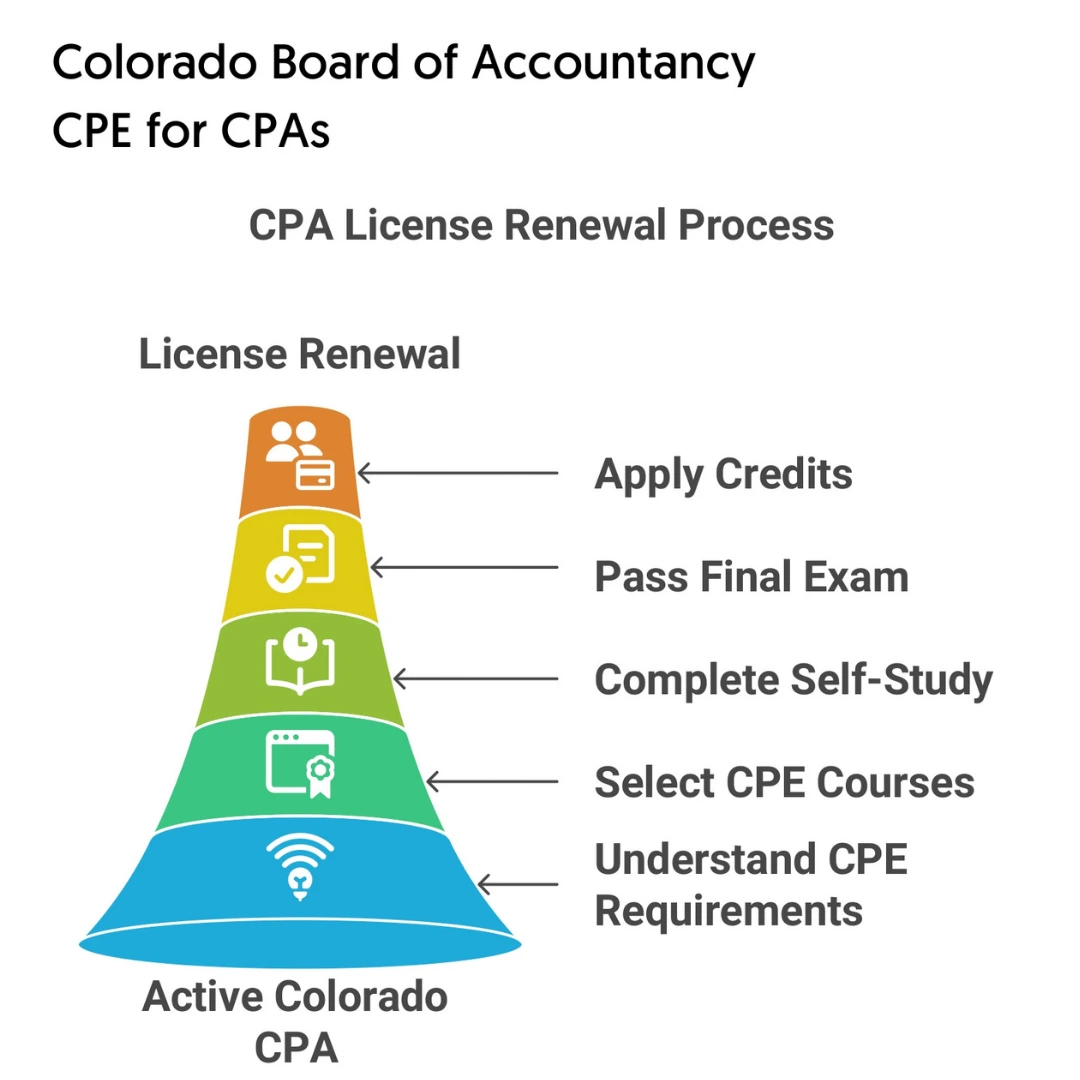
Before we start reviewing Colorado CPA license requirements, let’s learn the roles and responsibilities of the Board.

Colorado Board of Accountancy: Roles and Responsibilities

Role In the Accounting Profession:

The Colorado Board of Accountancy isn’t just a licensing and governing body. It’s a guardian of professional competence and ethical standards in the accounting profession. Through the enforcement of standards and the requirement of continuing professional education, it ensures that Colorado CPAs provide individuals, businesses, and government entities with reliable financial guidance.

Primary Responsibilities:

  • Ensuring active license holders meet Colorado CPA education requirements.
  • Investigating complaints against CPAs and public accounting firms to protect the public interest.
  • Taking disciplinary actions for violations of the rules and regulations.

Colorado CPE Requirements: Key Things to Remember

You need to remember these things for a smooth Colorado CPA license renewal.

  • All CPA licenses expire on November 30 of odd-numbered years.
  • The two-year CPE reporting period runs from January 1 of even-numbered years to December 31 of odd-numbered years.
  • To meet Colorado CPE credit requirements, you need to earn 80 credits every two-year period.
  • During the reporting period, you must obtain 10 CPE credits per full calendar quarter.
  • Each reporting period, you must complete four hours in ethics to fulfill Colorado CPA ethics requirements. You may not obtain more than two credits in Colorado Rules & Regulations.
  • You can get all the required credits through self-study programs.
  • You can earn a maximum of 16 CPE credits by completing courses related to personal development.
  • In a reporting period, you can obtain up to 40 credits by publishing materials and instructing relevant programs.

It’s vital to note that you cannot use Colorado CPA experience requirements, which involve 1,800 hours of relevant work, to maintain your license, as these two are separate requirements.

Other Important Things Related to Colorado CPA License Renewal

Keeping these things in mind will help you meet Colorado CPE requirements efficiently.

  • The Colorado Board of Accountancy doesn’t pre-approve CPE sponsors or programs. However, it accepts credits obtained from CPE providers that are listed on NASBA’s National Registry of CPE Sponsors.
  • If your principal place of business is outside of Colorado, you may demonstrate CPE compliance by giving in writing that you’ve met the CPE requirements in that state during each year from the date of your last renewal or license issuance.

Who Does the Information Regarding Colorado CPA License Requirements Help?

A clear understanding of Colorado CPA education requirements helps:

  • Aspiring CPAs looking to get a clear idea of the continuing professional education in the state.
  • Licensed CPAs trying to maintain a smooth license renewal process by meeting Colorado CPE credit requirements on time.
  • Public accounting firms trying to maintain compliance with state regulations.

By ensuring that the CPE requirements are properly met, the Board helps all stakeholders benefit from a reliable accounting environment.

What Problems Does the Information Solve?

The information helps navigate the challenges of:

  • Fulfilling the current Colorado CPE requirements along with specific ethics requirements efficiently.
  • Finding the right providers for CPE programs.
  • Missing license renewal and CPE reporting deadlines that may lead to disciplinary actions.
  • Keeping abreast of the evolving accounting standards and regulations.

When Does the Information About Colorado CPE Credit Requirements Become Relevant?

The information becomes relevant:

  • During each full calendar quarter, within which all active Colorado CPAs must earn 10 CPE credits.
  • During license renewal.
  • During audits of compliance that are carried out after every renewal reporting period.

Where Can You Apply the Information?

The information about the Colorado Board of Accountancy applies to the entire state of Colorado. Furthermore, if you want to apply for a reciprocal license, you need to have a clear comprehension of the Colorado CPE requirements. This is because, once you receive a Colorado license through reciprocity, you must meet all its CPE requirements to maintain it.

Why Should You Prioritize This Information?

This information is important because:

  • You must have an active CPA license to practice public accounting in Colorado. To maintain your license’s active status, fulfilling Colorado CPA education requirements is mandatory.
  • It helps you provide ethical, reliable accounting services, safeguarding consumers from negligence or fraud.
  • It helps maintain your professional competence and credibility while enhancing your earning potential.
  • It helps you avoid disciplinary actions that may arise from non-compliance with Colorado CPE requirements.

How Can the Problems Be Solved Using This Information?

Here are the most effective ways to solve the above-mentioned problems.

  • Take a thorough look at the Colorado CPE credit requirements, as you need to choose courses based on them. Remember the credit limitations mentioned above to ensure you don’t waste your effort, time, and money earning credits that might not be considered by the Colorado Board of Accountancy.
  • Join self-study courses to fulfill CPE requirements as they offer maximum flexibility. Self-study programs are also the most cost-effective among all methods to obtain CPE credits.
  • Ensure that your chosen providers are listed on NASBA’s National Registry of CPE Sponsors. For instance, you can check our details on the registry here.
  • Make sure that you earn at least 10 CPE credits each calendar quarter.
  • Fulfill Colorado CPA ethics requirements properly, as this is essential to maintain compliance with CPE requirements. As set forth by the Board, don’t complete more than two hours in Colorado Rules & Regulations. Also, ensure that CR&R courses adhere to the guidelines mentioned by the Board.
  • Retain all your CPE documents for at least five years, as you may need to submit them to the Colorado Board of Accountancy in case of an audit.

Closing Thoughts

The Colorado Board of Accountancy is more than a regulatory body. It’s the steward of financial integrity in the state. By ensuring that all active CPAs fulfill ongoing education requirements, it helps the public receive trustworthy guidance in a dynamic financial environment.

 

seperator


Check out what other customers are saying.


Click to go to: Cpethink.com Home
Thank you for taking one of our free courses. We would like to be able to let you know when we add free courses or have special offers and will never spam you or share your address with anyone. If you are Ok with that please reply with "Ok" or if not please reply "No Thanks". Either way enjoy your free CPE course.
  
Exam completed on .

Do you want to add the course again?